

European grapevine moth
Lobesia botrana
Description
How to identify
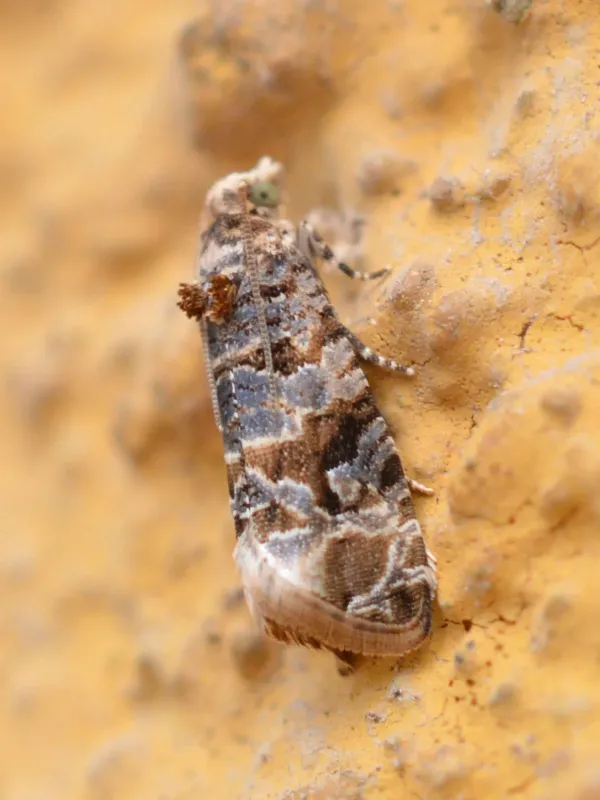
The European grapevine moth (Lobesia botrana) belongs to the Tortricidae family. The adult moth is small, with a wingspan of approximately 12–13 mm, displaying a mottled pattern of grey, brown, and metallic blue markings on its forewings.
The larvae are approximately 10–13 mm long and transition through five stages of development, changing color from pale yellow to olive-brown as they mature.
Pupation occurs within a silken cocoon, which the larvae weave in hidden locations such as bark crevices, leaf folds, or under plant debris to survive adverse conditions.
The life cycle is heavily dependent on regional climate, with the number of generations per year varying from two in cooler regions to four in warmer Mediterranean climates.
Adult moths are primarily nocturnal, showing peak activity during twilight hours, which is the optimal time for monitoring using pheromone traps.
What it damages
While the vine is the primary host, Lobesia botrana is a polyphagous pest capable of infesting other crops such as apples, pears, cherries, and occasionally garden vegetables like cabbage and potatoes.
The larvae primarily target the reproductive parts of the plant, including flowers and developing fruit, which significantly reduces the potential harvest.
By piercing the skin of the grapes, the larvae create entry points for secondary infections, most notably grey mold (Botrytis cinerea), which can devastate an entire vineyard.
Economic damage is twofold: physical destruction of the fruit by larval feeding and the qualitative loss caused by associated fungal pathogens, making the harvest unsuitable for processing.
Severe infestations can lead to complete loss of clusters, as larvae web multiple berries together and consume the pulp until the bunch is destroyed.
Signs of infestation
Early infestation signs include clusters of flower buds webbed together by silk, which leads to withering and the failure of normal fruit set.
As the fruit matures, individual berries may show darkening or shriveling, indicating that a larva has burrowed inside to feed on the developing seeds and pulp.
The presence of larval excrement, appearing as small dark pellets caught in silk webbing between grapes, is a definitive sign of an active infestation.
In the late season, infected clusters often show symptoms of rot, with berries turning purple or black as they succumb to fungal growth facilitated by the moth's activity.
Visual inspection of the vineyard, combined with pheromone trap data, provides the necessary insight to assess the pest density and decide on intervention.
Control measures
Cultural control practices include the removal of loose bark from vines and the destruction of leaf litter where pupae overwinter, reducing the initial pest population.
Biological control involves the use of parasitic wasps like Trichogramma, which target the moth's eggs, or the application of Bacillus thuringiensis to manage larval populations.
Chemical control must be timed precisely to coincide with the hatching of larvae, before they penetrate the berries where they become protected from insecticide applications.
Integrated Pest Management (IPM) strategies, including mating disruption using pheromone dispensers, are highly effective in suppressing the moth population over large areas.
Always rotate insecticides with different modes of action to prevent the development of pesticide resistance, ensuring long-term sustainability of the vineyard health.
In brief
10
Damages crops
Content graph
Damages crops · 10
Content graph
Connections · European grapevine moth
Most often together:
Marketplace
Products · 43


TRANSPORTABLE MUSCAT
ФГБНУ Дагестанская селекционная опытная станция виноградарства и овощеводства
Grape
0
0
·
45
32 offers
0.45 €per seedling
Buy


MUSCAT DERBENT
ФГБНУ Дагестанская селекционная опытная станция виноградарства и овощеводства
Grape
0
0
·
46
No offers
—
Details

DAGESTAN AMBER
ФГБНУ Дагестанская селекционная опытная станция виноградарства и овощеводства
Grape
0
0
·
37
No offers
—
Details
Biology
Taxonomy
- Latin name
- Lobesia botrana
- Order
- Lepidoptera (butterflies)
- Family
- Tortricidae
- EPPO code
- POLYBO
Community
Discussion
No discussions yet — be the first.