

Pest · Coleoptera (beetles) · affects Potato, Winter wheat, Fodder beet
Potato ladybird
Epilachna hirta
Description
How to identify
The potato ladybird (Epilachna hirta) belongs to the Coccinellidae family, but unlike its carnivorous cousins, it is a significant agricultural pest that feeds exclusively on plant tissues, specifically targeting members of the Solanaceae family.
Adult beetles are semi-spherical in shape, measuring 6–8 mm in length, and are covered in short, dense hairs. Their color ranges from yellowish to reddish-brown, distinguished by 28 black spots on their elytra.
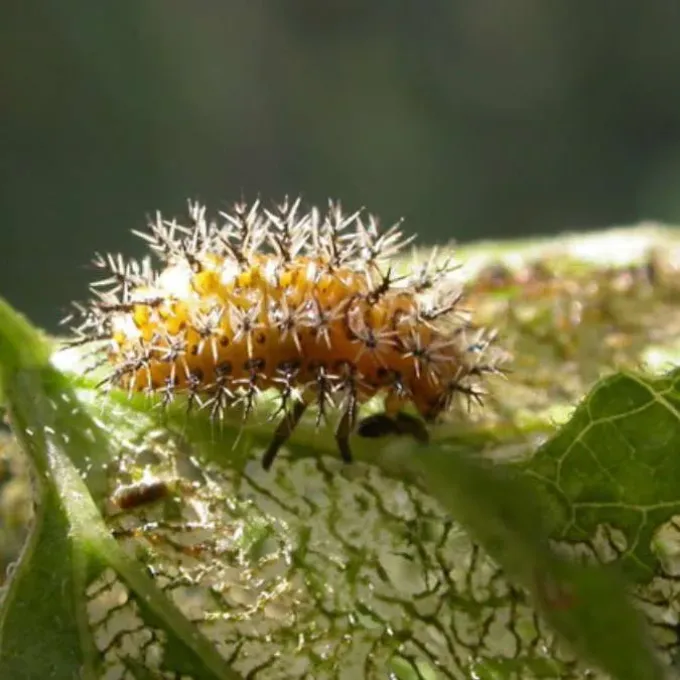
The larvae are bright yellow and are characterized by a series of branching spines covering their bodies. They move slowly and are typically found feeding in clusters on the undersides of leaves.
The life cycle involves complete metamorphosis, consisting of eggs, larvae, pupae, and adults. Eggs are laid in batches, usually appearing as bright yellow or orange clusters attached to the leaf surface.
During the cooler months, the adults enter diapause, hiding in soil debris, leaf litter, or sheltered areas near fields. As temperatures rise in spring, they emerge to begin their life cycle on host plants.
What it damages
The potato ladybird primarily affects potato plants, but it is also a major pest for tomatoes, eggplants, and peppers. In the absence of primary crops, they may also infest wild solanaceous weeds.
Damage is caused by both adults and larvae, which scrape away the leaf parenchyma, leaving the veins intact. This process is known as skeletonization, which causes the leaves to curl, brown, and eventually die.
Severe infestations lead to a total loss of photosynthetic surface area, which directly inhibits the plant's ability to produce tubers or fruits, leading to significantly lower yields.
The pest also creates entry points for secondary infections, such as bacterial or fungal pathogens. Damaged plants are generally weaker and more susceptible to various environmental stresses.
In high populations, the damage can spread rapidly across a field, destroying vast areas of foliage within a short window of time if interventions are not applied promptly.
Signs of infestation
The most recognizable sign is the "windowing" effect on leaves, where the soft tissue is removed, leaving a net-like skeleton of the leaf structure behind.
Early identification can be made by spotting clusters of yellow, elongated eggs on the underside of foliage. Finding these is a clear signal to begin management practices immediately.
Observing adult beetles or the spiny larvae on the foliage confirms the presence of the infestation. They are usually found in larger numbers on the upper leaves during the early morning hours.
Wilting of young shoots or leaves that suddenly exhibit yellowing and necrosis, despite adequate irrigation, is often an indicator of heavy feeding by colonies of the potato ladybird.
The presence of fine dust-like frass on the leaf surfaces or below the plant canopy is another telltale sign that a colony has established itself and is actively feeding on the crop.
Control measures
Controlling the potato ladybird requires a multi-faceted approach, incorporating cultural, biological, and chemical methods to ensure a healthy harvest while minimizing environmental impact.
- Hand-picking larvae and beetles during early morning hours when activity is low.
- Removing plant residues and weed hosts from the field after the harvest to eliminate overwintering sites.
- Implementing crop rotation to disrupt the life cycle of the pest by introducing non-host species.
- Using systemic insecticides at the first sign of significant threshold levels.
- Utilizing biological control agents, such as entomopathogenic fungi or predatory insects, to manage the population density naturally.
Chemical control programs must be timed correctly with the insect's development stages. Rotation of insecticide classes is necessary to prevent the buildup of resistance in the population.
Monitoring using visual inspection and localized traps allows for precise timing of treatments, reducing the need for broad-spectrum spraying and protecting beneficial organisms in the ecosystem.
Maintaining robust plant health through balanced fertilization and adequate water management helps the crop recover faster from localized feeding damage and increases tolerance to pest pressure.
Reference
Connections · Potato ladybird
Most often together:
Marketplace
Products · 7
Biology
Taxonomy
- Latin name
- Epilachna hirta
- Order
- Coleoptera (beetles)
- Family
- Coccinellidae
- EPPO code
- EPILHI
Community
Discussion
No discussions yet — be the first.