
Eye-spotted lady beetle
Anatis ocellata
Description
How to identify
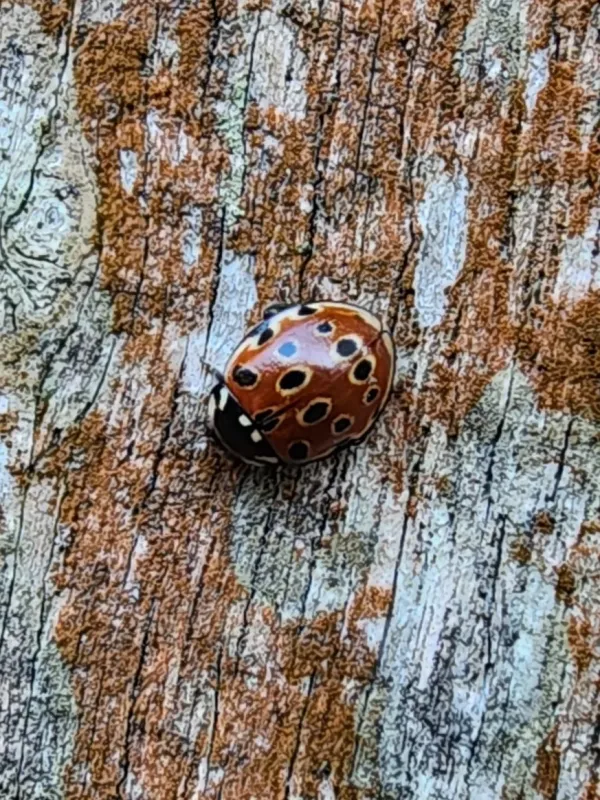
The eye-spotted lady beetle (Anatis ocellata) is a large ladybird species, typically reaching 7 to 9 mm in length. Its most notable feature is the presence of yellowish or white rings surrounding black spots on its reddish-brown elytra, which resemble human eyes.
The insect possesses a broad, oval-shaped body with a smooth, glossy surface. The larvae are characterized by a dark grey to black color, often marked with distinctive light-colored lateral spots across their segments.
Adult beetles are highly active during daylight hours and are capable of swift flight, which facilitates their colonization of new coniferous habitats during the peak growing season.
The life cycle is complete, involving egg, larval, pupal, and adult stages. This developmental process allows the species to effectively adapt to various environmental pressures throughout the year.
Females lay their eggs in clusters, usually on the underside of pine needles or within bark crevices, providing the larvae with initial cover from environmental stressors and potential predators.
What it damages
These beetles primarily inhabit conifer species, including Scots pine, spruce, and larch. They live within the tree canopy, where both adults and larvae spend the majority of their lifecycle hunting and feeding.
While often viewed as beneficial predators, high populations can create ecological imbalances if they outcompete other natural enemies that are vital for controlling primary forest pests, such as aphids and scale insects.
Damage is typically indirect, as the primary impact stems from the depletion of the natural pest control network in forest stands. This can lead to subsequent outbreaks of other pests that are normally suppressed by a diverse predator population.
In cases of extremely high density, the feeding activities of the larvae may cause minor mechanical damage to young needles, though this is rarely considered a major economic threat to healthy forests.
The presence of large populations can lead to increased stress on individual trees, as they may attract secondary pests that target the weakening defense systems of the host conifers.
When it appears
The active season for the eye-spotted lady beetle begins in late spring, once temperatures consistently remain above 15°C, triggering the emergence of adults from their winter dormancy.
Larval activity peaks throughout June and July, coinciding with the rapid growth of conifer needles and the reproductive cycles of various aphid species that serve as their primary food source.
Pupation occurs toward the end of summer, leading to the emergence of the next generation of adults, which begin preparing for hibernation as temperatures drop in early autumn.
Overwintering takes place in protected locations, such as under forest litter, inside bark fissures, or in dense moss, where the beetle remains until the following spring.
Seasonal transitions are critical for the survival of the population, as sudden weather shifts during hibernation or emergence can significantly influence the following year's abundance.
Signs of infestation
A key indicator of their presence is the discovery of larval exuviae (cast-off skins) on needles, which confirms that the insects have completed their development on specific branches.
During hot midday periods, adult beetles tend to congregate in shaded areas of the tree crown to prevent dehydration, making them easier to spot during forest inspections.
Signs of feeding on needles, appearing as minute, distinct punctures or localized necrotic spots, provide evidence of previous larval activity within the canopy.
The absence of established aphid colonies in areas where they were previously abundant often indicates successful predation by these lady beetles, highlighting their functional role in the ecosystem.
Professional forest monitoring often utilizes branch-beating techniques to collect samples and assess the population density of the beetles within specific stands.
Control measures
Integrated forest management is the preferred approach, emphasizing biodiversity to ensure that natural population checks and balances remain functional without excessive human intervention.
Chemical intervention should be restricted to highly specific scenarios, as broad-spectrum insecticides can devastate predatory beetle populations and lead to secondary pest outbreaks.
Silvicultural practices, such as proper forest hygiene and the removal of deadwood, can limit the availability of high-quality overwintering sites for the beetles, thereby managing their local density.
- Maintaining a diverse structure of forest stands.
- Encouraging the presence of insectivorous bird species.
- Targeted application of biological control agents.
- Regular monitoring via pheromone or light-based traps.
Strategic prevention and maintenance of natural ecological stability are the most effective tools for ensuring that these beetles remain a balanced part of the conifer ecosystem.
Taxonomy
- Latin name
- Anatis ocellata
- Order
- Coleoptera (beetles)
- Family
- Coccinellidae
- EPPO code
- ANATOC
Discussion
No discussions yet — be the first.