
Anatis
Anatis
Description
How to identify
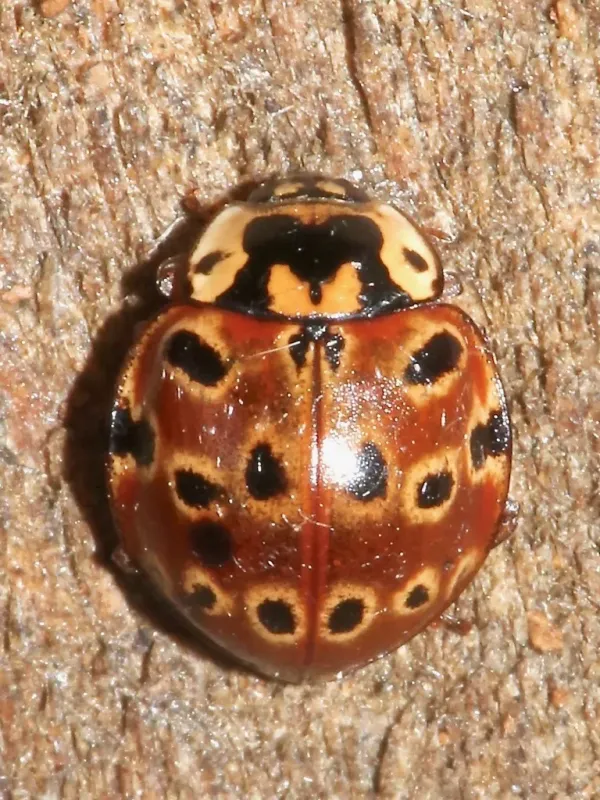
Anatis ocellata, commonly known as the eyed lady beetle, is a large member of the Coccinellidae family within the order Coleoptera, typically reaching 8–10 mm in length.
The adult beetle is easily identified by its distinctive reddish-brown elytra marked with black spots, each ringed by a light-colored halo, resembling an eye.
Its body shape is typically convex and rounded, which is standard for most ladybird species, but its size makes it one of the larger representatives of the family.
The larvae are equally distinct, often featuring dark tubercles and mottled patterns that provide camouflage against the rough bark of pine and spruce trees.
These beetles are primarily associated with coniferous forest ecosystems, where they play a vital role as predators of aphids and adelgids.
What it damages
While primarily entomophagous, Anatis ocellata can cause incidental damage to host plants when prey populations (aphids/adelgids) are insufficient for their nutritional needs.
They have been known to feed on the buds and needles of young conifer saplings, causing mechanical injury and physical deformation of the growing tips.
In forest nurseries, such feeding behavior can lead to reduced growth rates, chlorosis of the new foliage, and a weakened state that invites secondary pathogens.
This damage is generally more significant on young conifers, where the growth point is highly sensitive to tissue disruption caused by the beetle's mandibles.
However, it is crucial to note that the primary role of this beetle is beneficial, as it consumes large quantities of destructive sap-sucking insects.
When it appears
The life cycle begins in early spring when adults emerge from their overwintering sites, typically found in bark crevices or pine needle litter.
Peak activity and mating occur during the late spring and early summer months, aligning with the surge in aphid and adelgid populations on conifer hosts.
Females lay eggs in small clusters near prey colonies to ensure the larvae have immediate access to food upon hatching, which typically occurs within a few weeks.
The larval stage is characterized by intense feeding and rapid development, usually followed by pupation on the needles or twigs of the host tree.
Adults of the new generation appear in late summer and continue to forage until temperatures drop, triggering the onset of winter diapause.
Signs of infestation
The presence of Anatis ocellata is most easily confirmed by visual spotting of the beetles on pine or spruce branches, especially near aphid clusters.
Needle damage manifests as small, irregular lesions or gnaw marks, which are indicative of the beetle attempting to extract moisture or plant juices.
The presence of frass (excrement) on the bark or needles, different in consistency from the sticky honeydew of aphids, can also be a key diagnostic sign.
Stunted growth or curling of the terminal shoots on young conifers often serves as a late-stage warning of heavy local populations.
Chlorotic spots or localized yellowing on the needles can also indicate where the beetles have damaged the internal tissue structure.
Control measures
Management should focus on integrated pest control, as total eradication is counterproductive due to the beetle's primary role as a natural predator of tree pests.
If population numbers exceed economic thresholds in a nursery setting, utilize selective biological controls rather than broad-spectrum insecticides.
Preventative measures include maintaining tree vigor through proper irrigation and nutrition, which helps the trees withstand minor damage to new growth.
Sanitation practices, such as the removal of heavily infested or dead branches, can help manage local pest hotspots without damaging the beetle population.
- Monitor beetle counts during early summer
- Encourage natural predator diversity
- Avoid broad-spectrum pesticide spraying
Taxonomy
- Latin name
- Anatis
- Order
- Coleoptera (beetles)
- Family
- Coccinellidae
- EPPO code
- ANATSP
Discussion
No discussions yet — be the first.