
Description
How to identify
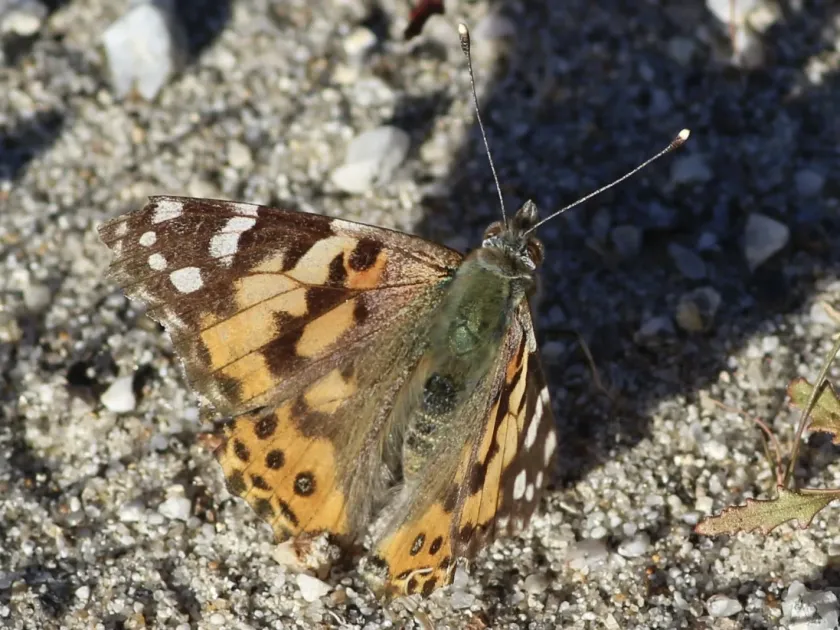
The Painted Lady (scientific name Cynthia cardui, formerly Vanessa cardui) is a migratory butterfly belonging to the Nymphalidae family. Adults have a wingspan of up to 60 mm, with orange-brown wings featuring distinct black and white spots.
The larvae, or caterpillars, grow up to 40 mm in length. Their bodies are covered in dense, spiny hairs and vary in color from yellowish-grey to nearly black, often marked with light longitudinal stripes along the sides.
Pupae are characterized by a metallic sheen and are typically found hanging from host plants, often protected within leaves that the caterpillar has rolled or tied together using silk webbing.
This species is a famous long-distance migrant, traveling thousands of miles. In favorable climates, it can produce multiple generations in a single growing season, leading to rapid population surges.
Adults are diurnal and highly mobile, feeding on nectar from various flowers, which sustains their energy for migration and reproductive activity across large agricultural landscapes.
What it damages
The Painted Lady is a polyphagous pest, meaning it feeds on a wide variety of plants. Key agricultural crops affected include sunflowers, soybeans, chickpeas, hemp, and various vegetables.
Heavy infestations are particularly damaging to sunflower and soybean fields. The voracious caterpillars can strip a plant of its foliage in a very short period, causing massive economic losses.
Loss of leaf surface area significantly hinders photosynthesis, which negatively impacts plant development, resulting in reduced seed yield, lower oil content in oilseeds, and overall plant weakening.
In outbreak years, these caterpillars can consume 30% to 50% of the leaf tissue, leaving plants severely stunted and unable to support successful grain or seed development.
Beyond cultivated crops, the caterpillars thrive on common weeds such as thistles (Cirsium and Carduus species) and nettles, which serve as primary hosts before the larvae migrate to commercial fields.
When it appears
Adult butterflies typically arrive in agricultural regions during the spring, having migrated from warmer southern regions to find suitable host plants for egg-laying.
The lifecycle from egg to butterfly takes roughly 30 to 45 days, depending heavily on the prevailing temperatures. Active feeding by caterpillars is most common during June and July.
Under warm summer conditions, two or even three generations can develop, causing the population density to increase significantly as the season progresses, posing a risk to late-maturing crops.
The highest level of damage usually coincides with the crop's vegetative and flowering stages, which are the most critical times for yield formation.
Warm, dry weather is ideal for their development. While heavy rains can reduce caterpillar numbers through mechanical disruption or disease, stable, dry weather usually triggers rapid pest proliferation.
Signs of infestation
The primary sign of an infestation is the presence of webbed, rolled-up leaves on the host plant. Caterpillars hide inside these structures while feeding on the leaf tissue.
Visible frass (caterpillar excrement) on the surface of the leaves and at the base of the plant is a clear indicator that a colony is active and feeding nearby.
Infested leaves often display an irregular, window-like feeding pattern, where the soft tissue is removed, leaving behind only the skeleton of larger leaf veins.
Eggs are typically laid singly on either the upper or lower side of leaves; they are very small and can be easily overlooked without careful field scouting.
Large patches of damaged foliage on the edges of fields or near weed-infested ditches are often the first visible signs that require immediate intervention.
Control measures
Field monitoring is the cornerstone of effective management. Regular scouting allows for the detection of egg clusters or early-stage caterpillars, which is vital for timely intervention.
Cultural control includes the destruction of host weeds like thistles and nettles on field perimeters, as these are the primary reservoirs for the pest during the early season.
When the economic threshold of damage is reached, insecticides from various classes, such as pyrethroids or organophosphates, are applied to control the larval population effectively.
Biological control using Bacillus thuringiensis-based sprays is an excellent option for integrated pest management, providing control while remaining safe for beneficial pollinators.
Application timing is crucial; treatments should be performed in the early morning or late evening to minimize impacts on bees and other beneficial insects present in the field.
Content graph
Connections · Painted Lady
Most often together:
Marketplace
Products · 1
Biology
Taxonomy
- Latin name
- Cynthia cardui
- Order
- Lepidoptera (butterflies)
- Family
- Nymphalidae
- EPPO code
- VANSCA
Community
Discussion
No discussions yet — be the first.