
Purple emperor
Apatura iris
Description
How to identify
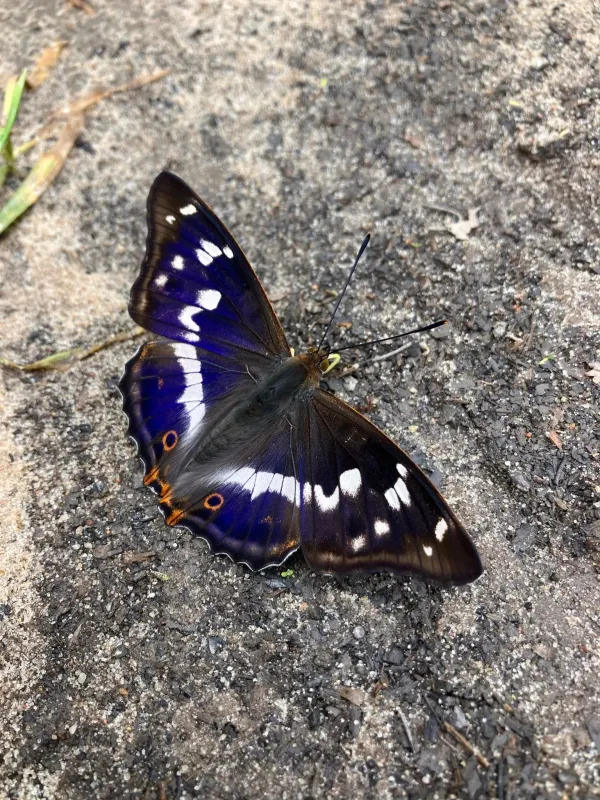
The Purple emperor (Apatura iris) is a large butterfly belonging to the Nymphalidae family. Males are famous for their iridescent purple-blue wings, which are highly visible in sunlight, while females are larger and possess dark brown wings.
The larvae, or caterpillars, are distinctively shaped. They are green with pale diagonal markings and have two prominent horns on their heads, which assist in mimicry when resting on the leaves of their host plants.
Pupae of the Purple emperor are green and smooth, hanging from the branches or underside of leaves. Their shape effectively imitates a folded leaf, providing excellent camouflage against birds and other predators.
Eggs are laid singly on the upper surface of host tree leaves. They are yellow and ribbed, making them a key indicator for early detection when surveying trees for potential infestations.
Adult butterflies have a secretive nature, often inhabiting the upper canopy of large trees. They are attracted to nutrient-rich substances like tree sap, rotting fruit, and carrion rather than just nectar.
What it damages
The primary damage is caused by the caterpillars, which feed exclusively on the foliage of willow species (Salix) and occasionally poplars. This feeding activity happens primarily in the spring and early summer.
Young caterpillars create small holes in the leaves, while older larvae consume significant portions of the leaf blade, often leaving the central midrib intact. This can lead to defoliation if the population density is high.
In nursery settings, heavy infestation can retard the growth of young saplings, reducing their overall vigor and affecting their development before they are ready for planting.
For mature trees, the damage is usually cosmetic and rarely impacts the long-term health of the plant. However, large outbreaks can lead to unsightly thinning of the tree crown.
The economic impact is generally low. Because the population is naturally regulated by parasites and predators, significant harm is rarely reported in well-managed ecosystems.
When it appears
The Purple emperor has a univoltine lifecycle, meaning it completes one generation per year. Adults are typically on the wing from late June through August.
Hibernation occurs at the larval stage. Young caterpillars, having developed to the second instar, attach themselves to a branch and turn brown, perfectly matching the bark of the host tree to survive the winter.
In spring, as the host tree buds break and new foliage emerges, the caterpillars resume feeding. This is the most active phase and the best time for monitoring the health of the trees.
Pupation takes place throughout June. After a few weeks, the adult butterflies emerge to start the cycle again, focusing on mating and laying eggs on the host trees.
Agronomists should prioritize inspections in the early spring, immediately following bud break, to assess the population density of emerging larvae and determine if any intervention is necessary.
Signs of infestation
The most reliable sign of a Purple emperor infestation is the presence of characteristic leaf damage, where large sections of the leaf are consumed, leaving only the primary veins.
Fecal pellets (frass) appearing on the leaves below the feeding site are clear evidence of caterpillar activity. Observing these deposits allows for the identification of the caterpillar's position in the canopy.
Visual identification of the caterpillars themselves is possible by examining the twigs and leaves for their unique horned, green appearance. They are often found resting along the main vein of a leaf.
Adult sightings are a strong indicator of a resident population. During sunny periods, butterflies can be seen patrolling their territory around the tops of willow trees.
- Irregular edges on leaves with remnants of midribs.
- Small, dark fecal pellets accumulating on lower leaves.
- Caterpillars with distinct head horns resting on foliage.
- Visible defoliation in young sapling clusters.
Control measures
Chemical intervention is rarely recommended for the Purple emperor, as it is a protected or rare species in many regions. Control should be limited to instances where nurseries are severely impacted.
Biological control using Bacillus thuringiensis (Bt) is the most environmentally friendly option. This bacteria targets butterfly and moth larvae specifically, minimizing impact on other garden insects.
Manual removal of caterpillars is highly effective on small-scale willow plantings. This is best achieved in the early spring when the larvae are still concentrated on specific branches.
Promoting a healthy garden ecosystem is the best long-term management strategy. Encouraging birds and parasitic wasps helps keep the caterpillar population at a naturally low level.
Always verify the local legal status of the species before implementing control measures, as the Purple emperor may be protected in certain territories due to its declining population in some areas.
Taxonomy
- Latin name
- Apatura iris
- Order
- Lepidoptera (butterflies)
- Family
- Nymphalidae
- EPPO code
- APTUIR
Discussion
No discussions yet — be the first.