
Lesser Purple Emperor
Apatura ilia
Description
How to identify
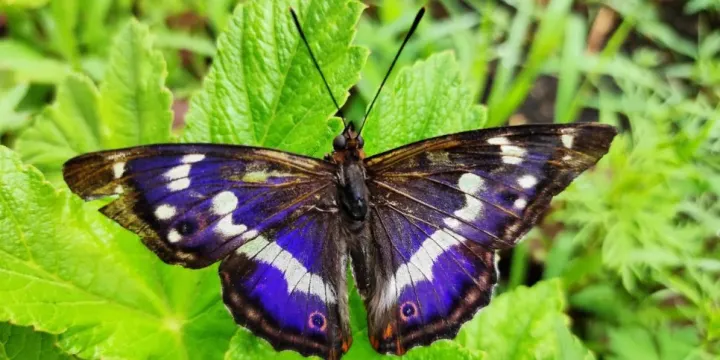
The Lesser Purple Emperor (Apatura ilia) is a butterfly belonging to the Nymphalidae family. Known for its distinct structural coloration, the male displays a brilliant purple-blue iridescence on its wings when viewed from certain angles.
Adult butterflies have a wingspan of approximately 70–80 mm. While males are characterized by their metallic sheen, females are generally larger and exhibit more muted brown tones with white spots, providing them with better camouflage.
The larvae, or caterpillars, are spindle-shaped and vibrant green, featuring diagonal yellow stripes along the sides. A defining feature is the pair of horn-like projections on the head, which aid in mimicking the midrib of a leaf.
The pupae are also bright green, effectively blending into the foliage of their host trees. They remain suspended from leaves or branches, adopting a shape that resembles a curled or damaged leaf tip.
This species is predominantly found in moist, deciduous forest habitats. They are agile fliers, though they spend the majority of their adult life in the high canopy of willow and poplar trees.
What it damages
The primary damage is caused by the larval stage of the insect. Caterpillars are specialized herbivores that feed exclusively on the leaves of host trees, primarily within the Salix (willow) genus.
Poplar trees are also occasionally utilized as host plants. In commercial willow nurseries, heavy infestations can lead to significant defoliation, which hampers the growth rate of young saplings and affects their vitality.
Adult butterflies do not damage plants. They possess a proboscis designed for liquid feeding, consuming tree sap, honeydew, floral nectar, and essential minerals from damp soil or decaying organic matter.
While the aesthetic impact on ornamental trees can be noticeable, the ecological damage in managed forests is usually minimal. The loss of leaf surface area reduces the tree's photosynthetic capacity during the growing season.
Secondary damage occurs when heavy feeding renders trees susceptible to opportunistic diseases or environmental stressors, particularly during periods of drought or nutrient deficiency.
When it appears
The life cycle of the Lesser Purple Emperor usually involves one or two generations per year, depending on the latitude and climate conditions. The flight period for adults typically spans from June through August.
Winter is passed in the larval stage. Caterpillars enter a state of diapause during their second or third instar, seeking shelter in branch forks or amongst leaf litter to survive the cold months.
As spring arrives and temperatures rise, the caterpillars emerge from their dormant state. They resume feeding on the newly developed buds and tender leaves, which are rich in the nutrients required for rapid larval development.
Pupation occurs in late spring or early summer. The pupal stage lasts approximately two to three weeks, depending on ambient temperatures, before the next generation of adults emerges to repeat the cycle.
Environmental conditions, particularly humidity and temperature stability during the spring, are critical. Extreme weather events can significantly influence population densities by affecting larval survival rates.
Signs of infestation
The most prominent sign of an infestation is the presence of irregular, notched feeding patterns along the margins of leaves. Caterpillars typically feed from the edge inward, leaving jagged holes.
Small, dark frass pellets accumulating on lower leaves or beneath the canopy are a reliable indicator of active larval feeding. This often directs an observer to look upwards for the caterpillars.
Because of their specialized coloration, larvae are often difficult to spot as they rest along the central vein of the leaf. Close inspection of the underside of foliage is required to confirm their presence.
The presence of pupae attached to stems or the underside of leaves indicates an ongoing reproductive cycle. These pupae are often mistaken for curled dead leaves, which is their primary defense mechanism.
In cases of high infestation, noticeable thinning of the canopy and premature leaf drop may occur. This suggests that the population density has exceeded the threshold where natural controls remain sufficient.
Control measures
Natural biological control is the most effective management strategy. Predators like birds, spiders, and parasitic wasps keep population levels stable in natural ecosystems without human intervention.
In ornamental garden settings, manual removal of larvae in the early morning is highly effective. This labor-intensive but non-toxic method prevents the need for any chemical applications in domestic spaces.
For larger nursery applications, biological insecticides containing Bacillus thuringiensis (Bt) can be used. These selectively target lepidopteran larvae and leave beneficial insect populations unharmed.
Cultural practices, such as removing fallen leaves and performing sanitary pruning, help to reduce the available overwintering sites for the larvae, thereby limiting the initial population for the following season.
Chemical intervention should be considered a last resort. If used, insecticides must be applied with precision to minimize the impact on local biodiversity and to ensure compliance with environmental safety regulations.
Taxonomy
- Latin name
- Apatura ilia
- Order
- Lepidoptera (butterflies)
- Family
- Nymphalidae
- EPPO code
- APTUIL
Discussion
No discussions yet — be the first.