

Pest · Coleoptera (beetles) · affects Winter rapeseed, Winter wheat, Fodder beet
Especially harmful
Pollen beetle
Meligethes sp.
Description
How to identify
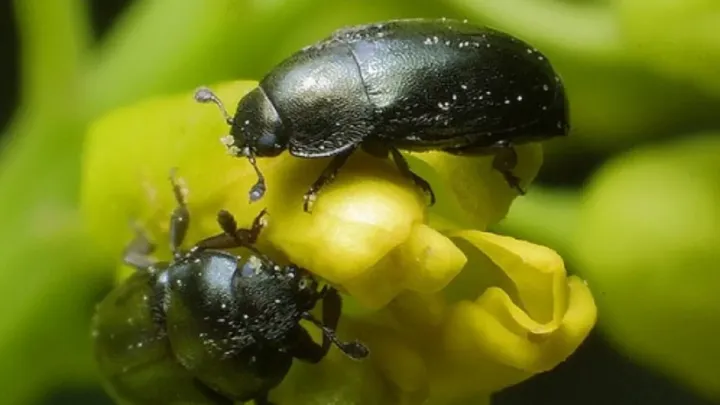
The pollen beetle (Meligethes sp.) is a small beetle belonging to the family Nitidulidae. Adult beetles are typically 2.0–2.5 mm long, characterized by a metallic greenish or bluish-black coloration that makes them distinct in field conditions.
The larvae are cream-colored with a dark head and three pairs of thoracic legs. They develop inside the flower buds, feeding on pollen, which is essential for their maturation into adults. Their compact body shape allows them to penetrate closed buds efficiently.
What it damages
Pollen beetles primarily attack cruciferous crops, causing severe damage to winter and spring oilseed rape. They feed on the developing buds, destroying the reproductive organs of the plants.
While oilseed rape is their primary target, these beetles are polyphagous and can infest a variety of other plants. Documented host plants include soybean, peas, apple, peach, raspberry, cucumber, and fodder beet, where they feed on pollen and floral parts.
When it appears
Adults overwinter in the soil or under leaf litter and crop residues. They emerge in early spring as temperatures rise above 8–10 °C, migrating to early flowering plants to feed before moving to their main host crops.
The life cycle continues with mating and egg-laying during the bud formation stage of host plants. The entire developmental cycle from egg to pupa takes several weeks, depending on climatic conditions.
Signs of infestation
The most evident sign of infestation is the appearance of damaged buds that turn yellow, wither, and eventually fall off. This leaves the plant with empty flower stalks, which significantly reduces the yield of pods and seeds.
In heavily infested fields, the inflorescences look sparse. Growers can identify the presence of the pest by inspecting the buds for small holes, where adults have bored in to access the pollen.
Control measures
Integrated Pest Management (IPM) is essential for controlling the pollen beetle. Monitoring using yellow traps is the standard practice to determine the arrival of the beetles and the density of the population.
Chemical control involving pyrethroids or neonicotinoids should be applied only when the economic threshold is exceeded. It is crucial to choose application times that minimize impact on beneficial pollinators like honeybees.
Cultural practices include sowing early-maturing varieties to escape the peak infestation window and maintaining clean field margins by eliminating wild cruciferous weeds, which serve as early-season breeding grounds for the beetles.
In brief
14
Damages crops
Content graph
Damages crops · 14
Content graph
Connections · Pollen beetle
Most often together:
Marketplace
Products · 5


Biology
Taxonomy
- Latin name
- Meligethes sp.
- Order
- Coleoptera (beetles)
- Family
- Nitidulidae
- EPPO code
- MELISP
Community
Discussion
No discussions yet — be the first.