

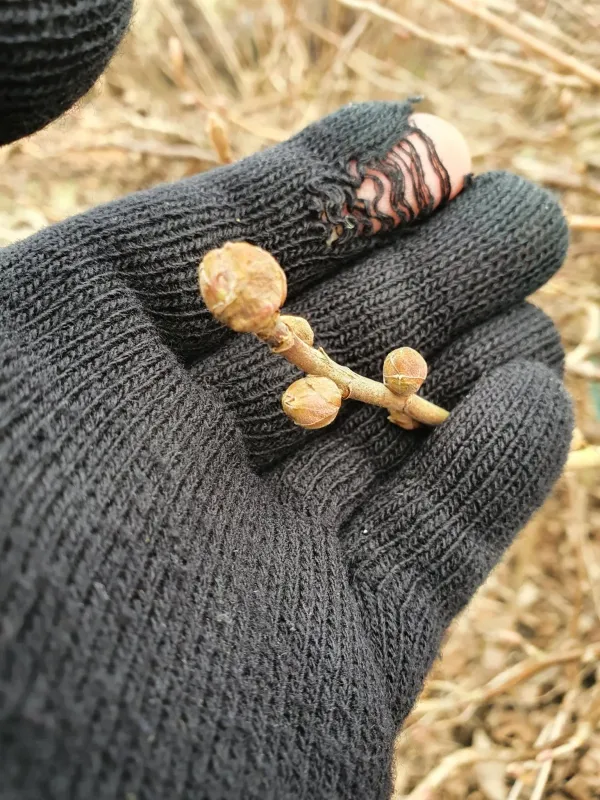
Description
How to identify
The blackcurrant gall mite (Cecidophyopsis ribis) is a microscopic pest belonging to the Eriophyidae family. Measuring only 0.2–0.3 mm in length, these worm-like mites are impossible to see without professional magnification.
These mites overwinter in colonies inside the buds of the currant bushes. During the spring bloom, adult females migrate from infested buds to new shoots, where they spread to healthy parts of the plant or are carried by the wind and insects to neighboring bushes.
The life cycle involves egg, larva, and adult stages. A single bud can house thousands of mites, which drain the plant's resources and lead to the structural deformation of the buds.
Beyond direct damage, this mite is a known vector for the "reversion" virus, which causes sterility in currants. Infested plants eventually stop producing fruit and remain a permanent source of infection in the garden.
Understanding the synchronization between the mite's migration cycle and the plant's development is crucial for successful pest management.
What it damages
The primary host is blackcurrant, although redcurrant, whitecurrant, and gooseberries can also be affected. The mites specifically target tender, developing buds that appear during the growing season.
Damage manifests as enlarged, globular buds that look like small cabbages. These buds fail to develop into normal flowers or shoots, significantly reducing the potential yield.
Direct damage causes the plant to lose vigor, stunted growth, and a reduction in overall cold hardiness. Over time, heavy infestations can lead to the death of entire branches.
The reversion virus introduced by the mite changes the leaf shape and causes flower deformity. Once a plant shows signs of viral infection, it cannot be cured and must be destroyed.
Left unmanaged, a mite colony can decimate a blackcurrant patch within a few years, making cultivation economically impossible.
When it appears
The peak migration period occurs during the flowering stage of the blackcurrant bushes. During this window, the mites actively move from old infested buds to newly developing growth.
Multiple generations of mites occur throughout the growing season. The speed of the life cycle is highly dependent on temperature, with warmer weather accelerating reproduction and spreading.
During the autumn, the mites enter newly formed buds intended for the next season's crop, settling in to survive the winter. This is the period when they are most protected from external treatments.
Monitoring for signs of infestation should begin in early spring before the buds open, as this is when the deformed "galls" are most visible against the healthy branches.
Late summer, after the harvest, is another essential time to inspect the shrubs and prune out any visible infestation to prevent further spread.
Signs of infestation
The most distinctive symptom is the presence of swollen, spherical buds that look distinctly different from the smaller, pointed healthy buds on the same twig.
In spring, infested buds either remain closed or produce distorted, chlorotic leaves that fail to grow properly. These buds are often described as "big buds".
If a bush is infected with the reversion virus, the leaves become less lobed (three-lobed instead of five-lobed) and the flowers turn a purplish color, remaining sterile.
Under a microscope, the interior of a gall bud reveals a dense cluster of cream-colored, microscopic mites.
Severe infestations cause a thin, sparse canopy with few healthy branches and a total lack of berries in areas where mites have been present for multiple seasons.
Control measures
The most effective strategy is a combination of cultural practices, including the strict removal and burning of all infested branches as soon as they are detected.
Starting with certified, mite-free nursery stock is the only way to ensure that your planting site remains clean from the outset.
Chemical control involves the use of acaricides applied specifically during the migration period, usually just before and during flowering, to hit the mites while they are exposed.
Some growers employ a hot water treatment for cuttings or small plants, carefully submerging them to kill the mites without damaging the plant tissues.
- Conduct regular visual inspections every spring and autumn.
- Prune and destroy all buds showing signs of swelling.
- Remove and destroy entire bushes showing symptoms of reversion.
- Apply authorized acaricides during the bud-burst and flowering window.
Content graph
Connections · Blackcurrant gall mite
Most often together:
Marketplace
Products · 4


Biology
Taxonomy
- Latin name
- Cecidophyopsis ribis
- Order
- Mites
- Family
- Eriophyidae
- EPPO code
- ERPHRI
Community
Discussion
No discussions yet — be the first.