
Cereal rust mite
Abacarus hystrix
Description
How to identify
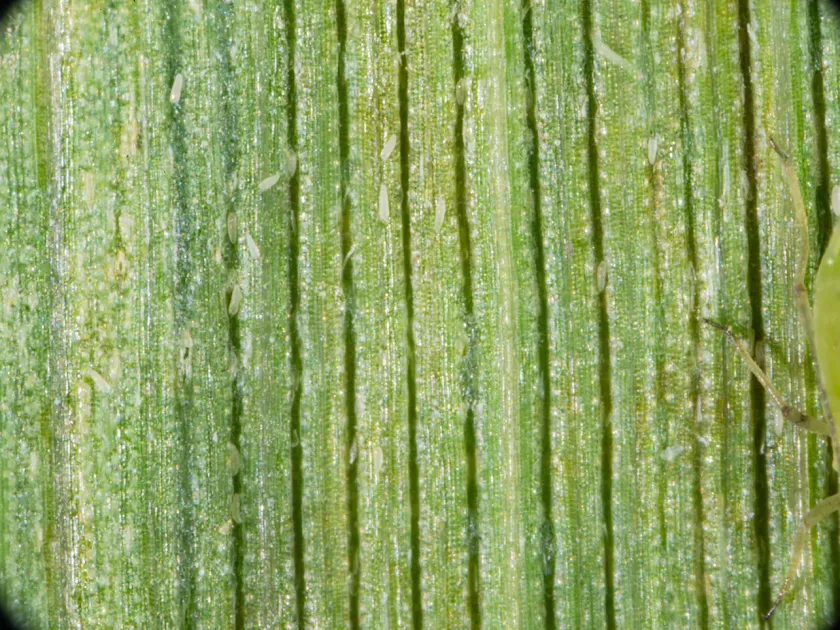
The cereal rust mite (Abacarus hystrix) belongs to the family Eriophyidae. These are microscopic arthropods characterized by an elongated, vermiform body shape and a creamy-white or light pink color.
Measuring approximately 0.2 to 0.3 mm in length, these mites are invisible to the naked eye, necessitating the use of specialized magnifying equipment or microscopy for accurate field identification.
They possess only two pairs of legs situated at the anterior end of the body, which is a diagnostic feature of this taxonomic family.
The life cycle involves an egg, two nymphal stages, and an adult stage. Under favorable environmental conditions, the entire life cycle can be completed in less than two weeks.
The mites are fragile and sensitive to desiccation, which explains their reliance on the micro-environments provided by the inner folds of grass leaves and leaf sheaths.
What it damages
The pest primarily targets small grain cereals, including wheat, barley, rye, and oats, as well as several species of wild perennial grasses found in adjacent areas.
Feeding occurs by piercing epidermal cells and extracting the sap. This process not only causes physical damage but also disrupts the physiological functions of the plant tissues.
The primary economic threat is the transmission of the Wheat Streak Mosaic Virus (WSMV). The mite acts as the essential vector for this devastating plant pathogen.
Heavy infestations lead to significant yield losses due to reduced photosynthetic capacity, stunted plant growth, and a high percentage of sterile florets in the ears.
The cumulative damage often results in uneven crop maturation, low test weight of the grain, and significant economic losses in regions where the virus is endemic.
When it appears
Mite activity generally commences in early spring as temperatures rise, enabling the migration from overwintering sites to emerging spring crops.
During the summer months, reproduction remains steady. However, the mites tend to migrate to the younger, more succulent tissues of the plant to avoid extreme heat.
The autumn period marks a critical phase as mites migrate to newly emerged winter cereals, which serve as the primary host for the survival of the population through winter.
Environmental conditions such as moisture levels significantly influence population dynamics, with dew facilitating the movement and establishment of the mites.
Overwintering occurs primarily on perennial grasses or volunteer cereals, which are vital for maintaining the mite population from one cropping season to the next.
Signs of infestation
Early signs of infestation include small chlorotic streaks on the leaves. These streaks often run parallel to the leaf veins and gradually increase in size.
As the mite population increases, the leaves may become twisted, curled, or exhibit premature necrosis, often leading to a general yellowing of the foliage.
Virus-infected plants exhibit distinct symptoms such as mosaic patterns, stunted growth, and yellowish streaking that may cover the entire leaf surface.
The reproductive organs of the plants are also affected, leading to malformed spikes, reduced seed set, and in severe cases, the failure of the plant to produce grain.
- Yellowish or whitish longitudinal streaks on leaves.
- Curling or rolling of leaf blades.
- Significant stunting of the overall plant height.
- Failure of heads to emerge or partial head sterility.
- Visible mosaic patterns caused by viral transmission.
Control measures
Integrated pest management (IPM) is the most effective approach. Cultural practices, such as the removal of volunteer wheat and grassy weeds, are critical for reducing local mite populations.
Establishing a "green bridge" free period between harvesting old crops and planting new winter cereals helps disrupt the life cycle and transmission of the virus.
Selecting resistant or tolerant crop varieties is a primary defense mechanism, particularly in areas with a history of high viral pressure and mite infestations.
Chemical control with acaricides is often difficult due to the cryptic nature of the mite's lifestyle and the rapid multiplication of populations under optimal weather conditions.
Strategic timing of planting is essential to minimize the window of exposure for young seedlings to migrating mites during the critical early growth stages.
Taxonomy
- Latin name
- Abacarus hystrix
- Order
- Mites
- Family
- Eriophyidae
- EPPO code
- ABACHY
Discussion
No discussions yet — be the first.