
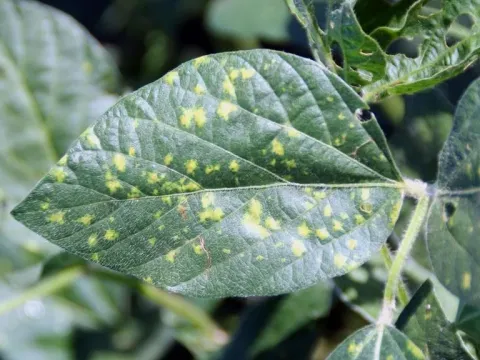
Soybean downy mildew
Soybean
The causative agent of soybean downy mildew is the oomycete Peronospora manshurica. As an obligate parasite, it belongs to the Peronosporaceae family and specifically infects plants within the Glycine genus.
What the section contains
Soybean downy mildew
The pathogen's life cycle is heavily dependent on moisture. Oospores, the sexual resting spores, overwinter in soil and on crop debris, remaining viable for several growing seasons until conditions for germination are met.
During the spring, primary infection occurs when oospores germinate and infect young soybean seedlings. These early infections serve as the initial inoculum source for spreading the disease across the field.
The secondary infection cycle is driven by sporangia, which are dispersed by wind and splashing rain. Under favorable conditions—high humidity and moderate temperatures—the pathogen can complete its cycle in just a few days.
Seeds are a significant vector for the pathogen. Oospores on the seed coat facilitate the introduction of the disease into new fields, making high-quality, disease-free seed selection a top priority.
The disease impacts all aerial parts of the plant, including cotyledons, leaves, stems, and pods. Early-season infections are particularly damaging as they can cause severe stunting and even the loss of young seedlings.
Leaf infection reduces the photosynthetic capacity of the plant, which is crucial during the critical stages of flowering and pod filling. As the disease progresses, leaves yellow and drop prematurely, cutting short the vegetative growth period.
The yield loss can be substantial, often ranging from 10% to 30% in high-pressure years. Beyond the quantitative loss, the seed quality is severely compromised, leading to shriveled or discolored seeds that are poor candidates for future planting.
Infected pods often harbor the pathogen internally, which reduces the marketability of the harvested soybean crop. Such produce is frequently rejected or discounted in commercial grain channels.
Furthermore, plants weakened by downy mildew are significantly more susceptible to secondary pathogens. This synergistic effect often results in a rapid decline of the entire field's health, requiring immediate intervention.
Symptoms initially appear as small, light-green spots on the cotyledons. As the disease advances, these spots expand into yellow lesions on the upper leaf surface, while a greyish-purple fungal growth appears on the underside of the leaves.
The infected leaf tissues eventually turn brown and become necrotic. In severe cases, the coalescence of these lesions leads to large, dead patches on the leaves, followed by widespread defoliation.
Pod symptoms may be subtle from the outside, but inspection of the inner pod walls often reveals a thick, greyish crust consisting of fungal spores. The seeds inside may appear coated in a white or greyish dust.
Systemic infection is a more severe form where the entire plant shows signs of dwarfism and leaf curling. The foliage becomes heavily covered with sporulation, indicating that the fungus has successfully colonized the vascular tissues.
- Light-green chlorotic spots on the upper side of leaves.
- Characteristic greyish-purple fungal growth under leaves.
- Premature leaf necrosis and defoliation.
- Grey powdery spore coating on seeds within pods.
- Overall plant stunting and vascular distress.
The most effective strategy for managing downy mildew is the use of resistant soybean cultivars. Breeding programs focus on selecting varieties that limit the pathogen's ability to establish and spread.
Cultural practices, specifically a well-planned crop rotation (at least 3 years), are essential. Moving away from continuous soybean cropping helps to reduce the primary inoculum load in the soil.
Deep plowing and the burial of crop residues are recommended to accelerate the decomposition of infected material. This process reduces the survival time of oospores and lowers the risk of primary infection in the following season.
Seed treatment with systemic fungicides is a standard preventive measure. Applying effective protectants to seeds creates a chemical barrier that shields seedlings from initial infections during the early growth stages.
If environmental conditions favor disease development, foliar fungicide applications are necessary. Utilizing products containing copper or modern systemic fungicides during the early flowering phase can prevent large-scale outbreaks.