
Southern corn leaf blight
Bipolaris maydis
Description
How to identify
The causative agent of the disease is the fungus Bipolaris maydis (syn. Helminthosporium maydis), an ascomycete pathogen. It is a serious plant pathogen that produces conidia, which are easily disseminated by wind, splashing rain, and insects.
The fungus overwinters as mycelium and conidia in crop debris, soil, and on infected seeds. During the growing season, it continues to cycle, producing new crops of conidia that serve as secondary inoculum for neighboring plants.
High humidity and warm temperatures, specifically between 20°C and 30°C, are optimal for the germination of spores and subsequent infection of corn tissues. Leaf wetness is critical for the pathogen to penetrate the leaf surface.
Once inside the plant tissue, the pathogen releases toxins that cause cell death and lesion formation. The fungus colonizes the tissue, eventually bursting through the epidermis to produce new spores.
There are several physiological races of Bipolaris maydis. Race T is historically significant due to its extreme aggressiveness and ability to devastate corn hybrids containing specific cytoplasmic male-sterile traits.
What it damages
The disease impacts all aerial parts of the corn plant, including leaves, sheaths, stems, husks, and kernels. Damage to the leaf canopy is the most critical factor, as it drastically reduces the plant's capacity for photosynthesis.
Severe infestations lead to premature leaf senescence and death, resulting in stunted ear development and significantly lower test weights. In epidemic years, yield losses can exceed 50% across large fields.
Infection of the husks and ears results in moldy grain and poor quality, which can make the crop unsuitable for storage. This also increases the risk of mycotoxin contamination, which is a major concern for feed and food safety.
Seedlings infected by the pathogen may die shortly after emergence or show severe chlorosis and retarded growth, leading to reduced plant stands and inconsistent crop development.
The weakened plant tissue is more susceptible to secondary infections by other stalk and ear rot pathogens, further compounding the damage caused by the initial fungal attack.
Signs of infestation
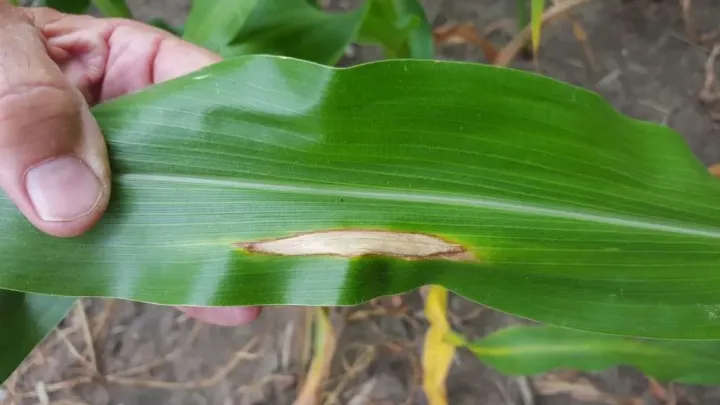
Early symptoms appear as small, tan, oblong lesions that gradually expand. As the disease progresses, these lesions become rectangular, following the leaf veins, which is a diagnostic characteristic.
The lesions often have a darker brown border and, in susceptible varieties, may be surrounded by a yellowish halo. When lesions coalesce, they can kill large portions of the leaf tissue, giving the field a blighted appearance.
In moist environments, the center of these lesions will turn a dark olive-brown or black color, which indicates the production of conidia. This velvety appearance is a clear sign of active fungal growth.
Ear infection appears as dark, mycelial mats on the surface of the kernels. In severe cases, the entire ear may become covered in a dark, fuzzy growth, leading to shriveled or discolored kernels.
- Tan, elongated rectangular lesions on leaves.
- Olive-black fungal growth in the center of lesions.
- Coalescing lesions leading to leaf death.
- Premature plant senescence and ear decay.
Control measures
The primary management strategy is the use of resistant corn hybrids. Choosing hybrids with documented resistance to Bipolaris maydis is essential, especially in areas with high annual rainfall.
Cultural practices such as crop rotation and the destruction of infected crop debris significantly reduce the primary inoculum load in the field. Tillage can help bury residue, accelerating decomposition.
Optimizing planting dates helps ensure the crop passes through the most susceptible growth stages before the peak onset of spore production from surrounding fields.
Seed treatments with systemic fungicides are critical for protecting young seedlings and ensuring an even stand, preventing the early establishment of the pathogen.
Foliar fungicide applications during the growing season are effective if applied when the first symptoms appear. These treatments are often necessary in high-yield environments where disease pressure is consistently high.
Causes diseases · 1
Discussion
No discussions yet — be the first.