
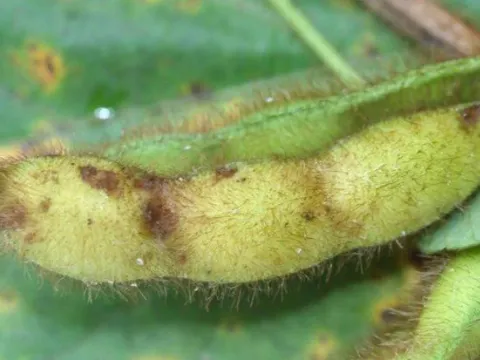
Soybean drechslera blight
Drechslera glycines
Soybean drechslera blight is a fungal disease caused by the pathogen Drechslera glycines. This organism is classified within the kingdom Fungi and is known to cause significant leaf spotting in various leguminous crops.
What the section contains
Soybean drechslera blight
The pathogen reproduces via conidia, which are easily dispersed by wind and rain splashes. It survives in the soil and on crop residues, acting as a persistent source of infection for subsequent growing seasons.
The biological cycle of the fungus is characterized by rapid sporulation under optimal conditions, typically involving temperatures between 20°C and 28°C and high relative humidity.
Systemically, Drechslera glycines belongs to the order Pleosporales. Its ability to penetrate host tissues through stomata or directly through the epidermis makes it a highly effective plant invader.
Proper identification usually involves microscopic examination of the conidiophores and conidia found on the necrotic lesions of the infected plant tissues.
The primary host for this pathogen is the soybean plant (Glycine max). The disease affects all parts of the plant, including leaves, stems, pods, and the seeds themselves.
The most severe damage occurs on the foliage, where extensive leaf spotting leads to premature senescence and defoliation, drastically reducing the plant's photosynthetic capacity.
Infection of the pods results in seed quality degradation, including discoloration and reduced weight, which significantly impacts the commercial value of the grain.
Furthermore, infected seeds can carry the pathogen internally or externally, introducing the disease into new fields or seasons, which complicates long-term management.
Yield losses can range from minor to significant depending on the timing of the infection; early-season outbreaks are particularly detrimental to final crop productivity.
The disease can appear throughout the entire growth cycle of the soybean. However, infection becomes most apparent and damaging during the flowering and pod-filling stages.
Warm, humid weather patterns with frequent rain events are the most critical factors driving the spread and intensity of the blight during the middle of the growing season.
Morning dew and lingering moisture on leaves provide the necessary conditions for fungal spores to germinate and infect the plant surface efficiently.
While dry conditions can temporarily suppress fungal activity, the pathogen remains viable on host debris, waiting for moisture to return to resume its active infection cycle.
As the season nears its end, the fungus enters a survival phase, residing in the crop residues left in the field until the next soybean crop is planted.
The infection typically begins as small, brown, circular or irregular spots on the leaves, often surrounded by a noticeable yellow chlorotic halo.
As the disease progresses, these lesions enlarge and coalesce, eventually covering large portions of the leaf surface and leading to tissue death.
Pod lesions appear as dark, sunken spots that may show signs of fungal sporulation if the environmental conditions remain sufficiently humid for extended periods.
- Brown spots on leaves with yellow halos.
- Sunken dark lesions on pods and stems.
- Premature yellowing and leaf shedding.
- Reduced plant vigor and stunted development.
- Seed discoloration and overall quality reduction.
Managing soybean drechslera blight effectively requires an integrated strategy that focuses on reducing the initial inoculum pressure in the field.
Crop rotation is one of the most effective cultural practices, as planting non-host crops for several years helps deplete the population of the pathogen in the soil.
Using certified, high-quality, and fungicide-treated seeds ensures that the crop starts with a clean foundation, reducing the risk of early-season systemic infection.
Deep tillage or residue management practices help bury infected plant debris, which accelerates the decomposition of host material and limits the survival of the fungus.
Foliar fungicide applications should be timed based on scouting and environmental conditions, targeting the early stages of disease development to protect the canopy and pods.