
Soybean dwarf
Soybean dwarf
The causative agent of the disease is the Soybean dwarf virus (SbDV), which belongs to the Luteovirus genus. This RNA virus is a significant pathogen specifically targeting various legume crops.
What the section contains
Soybean dwarf
The virus is not transmitted mechanically or through seeds. Instead, it relies on aphid species, most notably Aulacorthum solani, which serve as the primary vectors for the pathogen.
Transmission occurs in a persistent manner, meaning the aphid acquires the virus after feeding on an infected plant and remains infectious for the remainder of its lifespan.
Diagnostic identification relies on laboratory techniques such as Enzyme-Linked Immunosorbent Assay (ELISA) or Polymerase Chain Reaction (PCR) to detect viral particles within the host plant tissues.
Monitoring field edges is critical, as aphids often introduce the virus from surrounding vegetation or reservoir hosts into the soybean field early in the season.
The primary host for this virus is soybean (Glycine max). The disease causes substantial economic losses by reducing yields in temperate climatic regions worldwide.
Beyond soybeans, the virus infects various forage and wild legumes, which act as reservoirs that maintain the pathogen cycle during the off-season.
Infected plants exhibit a significant reduction in pod set and grain filling, resulting in lower total weight and poor seed quality at harvest.
Depending on the timing of infection and environmental factors, yield losses can range from 30% to 50%, with early-season infections being the most detrimental to crop development.
The disease often appears in localized patches within the field, leading to uneven maturation and complicating mechanical harvesting processes.
Disease development is closely linked to the lifecycle and migration patterns of the aphid vector, which typically begin when temperatures exceed +12°C to +15°C.
The most dangerous period occurs during the active vegetative growth phase of soybean. Aphid colonization frequently peaks in early summer, creating high infection pressure.
Cool and humid weather conditions are highly conducive to the rapid multiplication of aphids, accelerating the secondary spread of the virus across the crop.
Continuous aphid movement throughout the growing season ensures the ongoing dispersal of the virus from infected individuals to healthy ones.
As the season ends and soybean plants senesce, aphids migrate to overwintering hosts or weeds, carrying the virus with them into the next cycle.
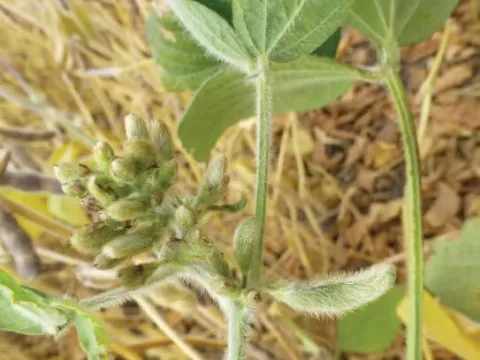
The most prominent symptom is the stunted growth of the plant, which is the defining characteristic of the disease and the origin of its name.
Leaves often display a distinct yellow or orange discoloration starting from the margins and spreading inwards, a condition known as marginal chlorosis.
Shortened internodes cause the plant to appear bushy and dwarf, while the upper leaves may show signs of deformation and curling.
- Marginal chlorosis on leaflets.
- Severe reduction in internode length.
- Delayed flowering and premature flower drop.
- Leaf wrinkling and upward cupping.
Host response can vary significantly by genotype, with some soybean varieties showing high susceptibility while others may exhibit milder symptoms.
Management focuses primarily on controlling the aphid population through the timely application of systemic or contact insecticides during early plant development.
Maintaining spatial isolation from perennial legume pastures or meadows can significantly decrease the initial viral inoculum entering the field.
Adjusting planting dates to ensure that the most vulnerable growth stages do not coincide with peak aphid migration can help minimize disease incidence.
The utilization of resistant or tolerant soybean cultivars remains the most effective and sustainable strategy for mitigating the impact of the virus.
Implementing a rigorous weed management program in and around the field reduces the number of reservoir hosts, thereby limiting potential infection sources.