
Soybean mosaic
Soybean mosaic
The causative agent of the disease is the Soybean mosaic virus (SMV), which belongs to the Potyviridae family and the Potyvirus genus.
What the section contains
Soybean mosaic
The virus consists of filamentous particles containing single-stranded RNA. It is one of the most widespread pathogens affecting soybean crops worldwide.
The primary source of infection in field conditions is infected seed material, where the virus is preserved in the seed embryo.
Vectors of the pathogen during the growing season are various aphid species that transmit the virus in a non-persistent manner during short-term feeding.
The biology of the virus is closely related to the population dynamics of insect vectors, which spread it from primary infection sites to healthy plants.
Soybean mosaic virus affects exclusively plants of the Fabaceae family, primarily soybean. In some cases, it can affect other legume species that act as reservoirs.
The disease leads to a significant reduction in seed yield and deterioration of their seed quality, making them unsuitable for subsequent planting.
Infection of plants in early growth stages causes significant growth stunting, often leading to a complete loss of commercial value for affected plants.
Massive spread of the virus can reduce the 1000-seed weight and decrease the protein and oil content in beans, which is critical for the processing industry.
Damage is also manifested by reduced plant resistance to other abiotic and biotic stressors, which worsens the overall field situation.
Primary signs of infection can appear as early as the seedling stage if the seeds were initially infected with the virus.
Secondary infection occurs throughout the growing season, particularly during periods of mass migratory flights of aphid vectors.
Warm and humid weather conditions promote rapid aphid reproduction, which correlates with wider disease spread throughout the field.
The virus spreads in a patchy manner, starting from the edges of fields or from individual infected plants, gradually covering the entire planting area.
The disease development cycle in field conditions is inherently linked to the life cycle of vectors, whose peak activity typically occurs in June and July.
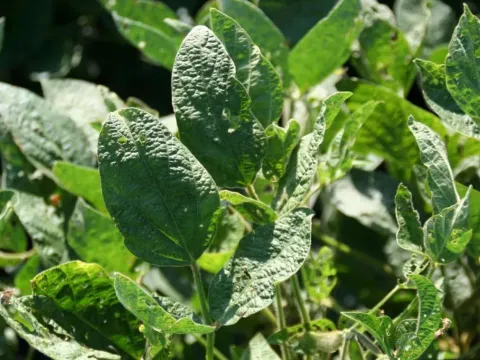
A typical symptom is leaf mosaicism — the alternation of light green and dark green areas, often accompanied by deformation of the leaf blade.
The edges of leaves on affected plants may curl downwards, the leaf surface becomes wrinkled, and plants often appear stunted and dwarf-like.
Sometimes, characteristic pigmentation (darkening of the hilum area) appears on the seeds, which is a diagnostic feature during crop inspection.
Early infection results in significant flower and pod drop, leading to the formation of very few pods or their complete absence.
- Vein yellowing of leaves
- Wrinkled leaf surface
- Reduced plant height
- Distortion of pod shape
The main control method is the use of healthy seed material, tested for the absence of viral infection in the seeds.
It is important to maintain spatial isolation of seed production fields from commercial fields and to eliminate weeds that may act as virus reservoirs.
Controlling aphid populations using insecticides during early growth stages helps reduce the rate of infection spread across the field.
Breeding and planting virus-resistant or tolerant soybean varieties is the most effective long-term method for crop protection.
Adherence to crop rotation and optimal sowing dates helps plants avoid peaks in vector activity, thereby reducing the probability of mass infection.