
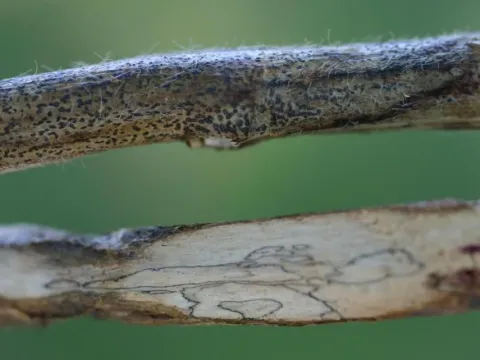
Macrophomina phaseolina
Sclerotium bataticola
Macrophomina phaseolina is a soil-borne fungal pathogen belonging to the Ascomycota division, known for causing charcoal rot in numerous crops.
What the section contains
Macrophomina phaseolina
The fungus produces microscopic black structures called microsclerotia, which serve as the primary survival mechanism in the soil for several years.
It acts as a facultative parasite, exhibiting wide host range adaptability, making it one of the most destructive pathogens in warm agricultural regions.
Pathogenesis occurs when fungal hyphae penetrate the root system, eventually colonizing the vascular bundles and disrupting the plant's nutrient transport.
The survival and propagation of the pathogen are highly dependent on high soil temperatures, often exceeding 28°C, and limited moisture levels.
This pathogen infects over 500 species of plants, including economically significant crops like sunflowers, soybeans, maize, and beans.
In sunflower cultivation, the disease causes premature senescence and death, leading to significant yield losses and reduced oil content in seeds.
Soybean plants exhibit seedling blight, root decay, and reduced pod development, which directly impacts harvestable biomass and seed quality.
Maize is particularly susceptible to stalk rot, causing plants to lodge easily, which complicates mechanical harvesting and leads to grain loss.
In hot and dry climates, the cumulative damage across various fields can result in total crop failure if the pathogen density in the soil is high.
Disease symptoms usually become apparent during the reproductive stages of crop growth, especially during grain or seed filling periods.
Infection is favored by environmental stress; specifically, high temperatures and drought conditions are primary triggers for the pathogen's aggressive phase.
Early season symptoms may appear as poor germination or damping-off, caused by the colonization of the roots by microsclerotia from the soil.
Mid-to-late summer heat waves often lead to rapid advancement of the disease, as the host plant's defense mechanisms are weakened by water deficit.
The life cycle concludes with the mass formation of microsclerotia within the dying plant tissue, ensuring the pathogen returns to the soil for the next season.
The characteristic sign of charcoal rot is the greyish-black discoloration at the base of the stem and the lower root system of the plant.
Upon removing the stem epidermis, one can observe a dense mass of black microsclerotia that looks like charcoal dust, hence the disease's name.
Plants display wilting during the hottest parts of the day, with stems eventually drying out and turning brittle, which is a classic symptom of xylem blockage.
Root rot is prevalent, often resulting in shredding of the cortical tissue and a stunted, malnourished appearance of the entire plant.
Premature leaf chlorosis and necrosis are visible early on, preceding the final drying out of the entire plant canopy.
Integrated pest management is essential, as no single method provides complete protection against this persistent soil-borne pathogen.
Crop rotation with non-host crops, such as wheat or certain grasses, is the most effective cultural practice to reduce the soil inoculum density.
- Utilizing resistant or tolerant crop varieties.
- Ensuring proper soil moisture management through irrigation to reduce heat stress.
- Applying systemic fungicide seed treatments to protect emerging seedlings.
- Managing plant density to minimize competition for soil moisture during the summer.
Sanitation practices, such as deep plowing to incorporate and decompose infested plant debris, help reduce the long-term survival of microsclerotia.