
Raspberry ringspot
Raspberry ringspot
Raspberry ringspot is a viral disease caused by the Raspberry ringspot virus (RpRSV). It belongs to the genus Nepovirus, a group of viruses primarily transmitted by soil-inhabiting nematodes of the family Longidoridae.
What the section contains
Raspberry ringspot
The virus is characterized by a bipartite genome of positive-sense single-stranded RNA. Its ability to infect a vast range of plant species makes it a persistent threat in both agricultural and wild settings.
Systemic infection is a hallmark of this pathogen. Once it enters the plant, it moves through the phloem, eventually reaching all parts, including the roots, leaves, and reproductive organs.
The specificity of nematode vectors means that the disease is localized in areas where these vectors thrive. The virus can persist in the soil for years inside these vectors, even in the absence of a host plant.
Detection involves advanced techniques such as ELISA (Enzyme-Linked Immunosorbent Assay) for screening and RT-PCR for molecular verification, which are essential for certifying disease-free planting material.
The economic impact of Raspberry ringspot is significant, particularly in commercial raspberry and strawberry production. Infection leads to severe stunting and a drastic reduction in total fruit yield.
Affected plants suffer from poor vegetative growth. The canes are often weak and brittle, leading to decreased winter hardiness and increased susceptibility to other environmental stressors.
In strawberries, the virus causes irregular fruit development and poor runner production, making the plants unproductive and often requiring the total removal of the affected beds.
Beyond direct yield loss, the virus shortens the economic lifespan of perennial plantings. This forces growers into earlier replanting cycles, increasing production costs and reducing profitability.
The virus also weakens the plant's overall physiology, making it highly susceptible to subsequent attacks by secondary pathogens, which can accelerate the decline of the entire plantation.
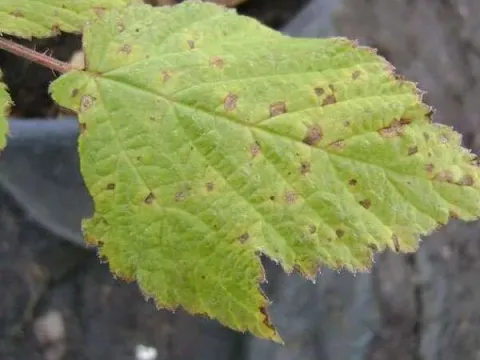
Visible symptoms typically appear on the foliage as chlorotic spotting, which later develops into distinct rings, lines, or arc-shaped patterns. Leaf deformation and wrinkling are common in susceptible varieties.
Stunted growth is frequently observed, where internodes are shortened, resulting in a bushy or stunted appearance. In some cases, the plants may show severe leaf distortion, mimicking other physiological disorders.
The expression of symptoms depends on the host cultivar, the viral isolate, and environmental conditions. Some cultivars may remain asymptomatic (latent infection), acting as hidden reservoirs for the virus.
In the spring, symptoms are often more pronounced as the plant begins active growth. Infected blossoms may be deformed, leading to poor fruit set and small, crumbly, or otherwise misshapen berries.
- Chlorotic rings or mosaic patterns on leaves.
- Leaf curling and deformation.
- Stunting of the entire plant.
- Shortened internodes.
- Deformed or poor-quality fruit production.
The primary control strategy is the use of high-quality, virus-tested planting material. Sourcing plants from certified nurseries that use tissue culture protocols is the most effective preventative measure.
Pre-planting soil testing for nematode populations is crucial. If vectors such as Longidorus are present in high numbers, soil fumigation or extended fallow periods may be necessary.
Strict sanitation practices must be employed. Infected plants must be rogued (dug up and destroyed) immediately upon detection to prevent the spread of the virus to healthy parts of the field.
Effective weed management is essential, as many common weeds act as alternative hosts for both the virus and its nematode vectors, providing a bridge for infection.
Crop rotation should be practiced in infested fields, avoiding susceptible crops for several years to help decrease the population of the virus-carrying nematode vectors in the soil.