
Raspberry leaf mite
Phyllocoptes gracilis
The raspberry leaf mite (Phyllocoptes gracilis) is a microscopic member of the Eriophyidae family, commonly known as gall mites. Due to their minute size and slender body, these pests are invisible to the naked eye and require magnification for positive identification.
What the section contains
Raspberry leaf mite
Morphologically, these mites possess a worm-like, elongated body with a yellowish or pale white appearance. They are characterized by having only two pairs of legs, which are situated near the front of the body, distinguishing them from other mite groups.
Their biological cycle is rapid, enabling multiple generations within a single growing season. During favorable warm and humid conditions, the population density can escalate significantly, causing severe stress to the host plants.
Overwintering occurs as fertilized females residing in protected areas, such as under bud scales, within bark crevices, or in leaf axils. As temperatures rise in early spring, they emerge to migrate toward the newly developing buds and leaves.
Spread across plantations is facilitated by the movement of infested nursery stock, wind dispersal, and occasional transport by insects, making strict quarantine of new plant material essential for commercial growers.
The primary host for this pest is the red raspberry (Rubus idaeus), though it can also infest blackberries. The mites feed by piercing cells on the lower surface of leaves and extracting plant fluids.
This feeding activity disrupts the metabolic processes within the leaf tissue, specifically interfering with photosynthesis and nutrient translocation. Over time, this leads to a reduction in the overall vigor and health of the raspberry canes.
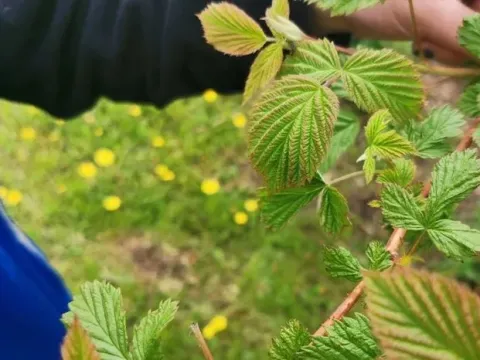
Persistent infestations result in structural changes to the foliage. Leaves often exhibit signs of curling, crinkling, and distortion, which significantly limits the plant's capacity to produce the carbohydrates necessary for fruit development.
The yield quality is severely compromised; fruits may become deformed, stunted, or dry out prematurely. Such damage renders the berries unmarketable and drastically reduces the commercial value of the harvest.
Long-term exposure to these mites causes chronic exhaustion of the root system. Affected plants eventually produce weak, spindly canes that are more susceptible to winter injury and various secondary pathogens.
Initial signs of infestation appear as small, yellowish, or chlorotic spots on the underside of the leaves. As the mite colony grows, these spots may expand and cause the leaf tissue to become mottled or bleached.
Distorted and gnarled leaf growth is a hallmark symptom. The leaves may curl downwards or become deeply wrinkled, creating a cupped appearance. This deformation is often mistaken for viral diseases or herbicide drift.
A closer inspection using a hand lens (at least 10x magnification) reveals clusters of tiny, elongated, white mites moving slowly along the veins of the leaves. Their presence is often accompanied by a fine, dusty appearance.
By late summer and autumn, severely infested plants display premature senescence. Leaves may yellow and drop earlier than normal, indicating that the plant’s energy reserves have been depleted throughout the season.
When monitoring the plantation, be alert for any abnormal leaf development on new shoots. Early detection is crucial, as the mites can spread across an entire block if left unchecked during the rapid growth phase.
Integrated Pest Management (IPM) begins with the selection of certified, mite-free nursery stock. Avoiding the introduction of infested materials is the most effective way to prevent long-term establishment in new fields.
Proper cultural practices are vital for suppression. This includes the systematic pruning and removal of old or heavily infested canes, which should be destroyed by burning to minimize the reservoir for overwintering females.
Chemical control usually involves the application of specific acaricides. The timing of these applications is critical and is most effective during the early spring emergence period when mites are actively moving toward the buds.
- Applying sulfur-based fungicides or acaricides in early spring.
- Using systemic or contact acaricides during the active growth phase.
- Regularly scouting fields to detect threshold levels of infestation.
Rotation of chemical products with different modes of action is necessary to prevent the development of resistance. Additionally, biological control agents and botanical oils can be incorporated into the strategy to reduce synthetic chemical dependence.