
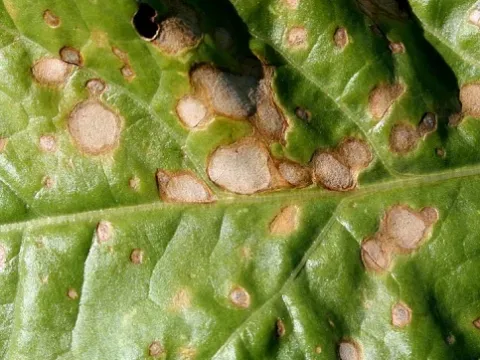
Beet leaf spot
Ramularia beticola
Ramularia beticola is a fungal pathogen belonging to the phylum Ascomycota. It is the causative agent of ramularia leaf spot, a disease that primarily affects various types of beets, including sugar beet, red beet, and mangelwurzel.
What the section contains
Beet leaf spot
The fungus overwinters in the soil on infected plant debris, which serves as a primary inoculum for the next growing season. It can also be transmitted through contaminated seeds, allowing it to spread to new geographic areas.
Under favorable environmental conditions, the pathogen produces conidia that are disseminated by wind, rain splashes, and irrigation water. These spores land on leaves and infect them through stomata, initiating the disease cycle.
Development of the fungus is favored by cool to moderate temperatures ranging between 15°C and 20°C combined with high humidity. Periods of persistent dew or light rain are particularly conducive to the rapid spread of the pathogen.
Microscopically, the pathogen is identified by its fasciculate conidiophores that emerge through the leaf stomata. These structures produce chains of hyaline conidia, which give the characteristic appearance of a white or grayish powdery layer on the underside of the leaves.
The primary economic impact of ramularia leaf spot is the premature senescence and death of the beet foliage. As the leaves die, the plant's ability to photosynthesize is severely compromised.
Because the photosynthesis rate drops, the accumulation of sucrose in the taproot is significantly reduced. This leads to a decline in both the total weight of the harvest and the sugar content, which is critical for industrial processing.
Heavy infestations can lead to substantial yield losses, sometimes exceeding 20 percent in favorable conditions for the fungus. Furthermore, damaged plants are more susceptible to secondary infections and rot during storage.
The disease typically starts from the older outer leaves and progresses inward. If left uncontrolled, it can result in total defoliation of the crop, forcing the plant to use stored energy to regrow leaves instead of developing the root.
In addition to sugar beet, the pathogen can infect other related Chenopodiaceae family members, acting as a potential source of infection for neighboring fields if not managed properly.
The first symptoms appear as small, gray-brown spots on the leaf blades. Unlike some other spot diseases, the margins of these spots are often less defined and irregular in shape.
A hallmark sign of Ramularia beticola is the presence of a white or pale gray fuzzy growth on the lower surface of the leaf, exactly at the center of the necrotic spots. This growth is most visible during humid or damp conditions.
As the infection progresses, the spots expand and coalesce. The entire leaf blade may turn yellow, wither, and collapse, beginning with the older, more mature leaves at the bottom of the canopy.
In severe cases, the infected leaf tissue may become brittle or fall out, leading to a "shot-hole" appearance. However, the overall chlorosis and necrosis are the most common field observations during the peak of the disease.
Petiole infection is possible but usually occurs in late stages of the disease. Observing the leaf canopy from the ground usually reveals a progression of the disease from the bottom up to the younger, inner leaves.
Crop rotation is the most effective cultural practice for managing ramularia leaf spot. A minimum three-year interval between beet crops helps to reduce the amount of inoculum surviving in the soil.
Deep plowing after harvest is essential to bury crop residues deep enough to accelerate their decomposition and prevent the survival of the pathogen. Weed management, especially for wild beet relatives, is also recommended.
The use of resistant or tolerant sugar beet varieties is a vital strategy. Breeders focus on selecting lines that show minimal leaf symptoms and maintain high sugar accumulation even under disease pressure.
Fungicide applications are necessary when the risk of infection is high or when the disease is detected early. Triazoles and strobilurins are commonly used and provide effective control if applied at the correct growth stages.
- Use certified, disease-free seed to prevent initial infection.
- Maintain balanced fertilization to improve plant vigor.
- Monitor fields regularly, especially during periods of high humidity and moderate temperatures.