
Beet curly top
Beet curly-top
The causative agent of the disease is the Beet curly top virus (BCTV), belonging to the genus Curtovirus of the Geminiviridae family. It is a virus with a single-stranded circular DNA genome transmitted exclusively by specific vectors.
What the section contains
Beet curly top
The primary vector of the infection is the beet leafhopper (Circulifer tenellus). The virus is not transmitted by seeds or mechanically via sap; therefore, the presence of the insect vector is critical for an epidemic to occur.
The incubation period of the virus within the leafhopper ranges from a few hours to several days after feeding on an infected plant. Once acquired, the insect remains viruliferous for its entire lifespan.
The virus infects the plant's vascular system, causing systemic infection. It primarily accumulates in the phloem cells, severely hindering the normal translocation of photosynthates throughout the host organism.
In the natural environment, the virus survives in numerous reservoir weed hosts from the Amaranthaceae, Chenopodiaceae, and Solanaceae families, where leafhoppers overwinter and reproduce early in the season.
The disease affects a wide range of agricultural crops, including sugar and table beets, tomatoes, peppers, beans, cucurbits, and spinach.
Sugar beets suffer the most significant damage, where the virus can lead to 80-100% crop loss during years of massive leafhopper population outbreaks.
In young plants, infection often leads to total plant death, as they lose their growth potential due to disrupted metabolism and severe vascular damage.
In mature plants, infection causes a drastic reduction in sugar accumulation in taproots, making them entirely unsuitable for industrial processing at sugar refineries.
Vegetable crops such as tomatoes exhibit stunted growth, yellowing, and total cessation of fruit production, leading to major economic losses in both field and greenhouse environments.
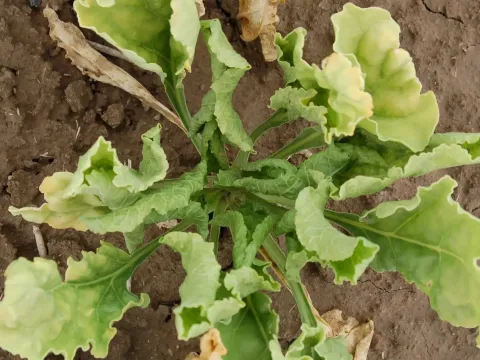
The first noticeable symptom is the yellowing of young leaves in the center of the rosette, followed by characteristic curling along the midrib, which causes the leaf edges to roll downward.
Leaf blades become thickened, rigid, and take on a leathery texture. In cases of severe infection, leaves may develop a reddish or bronze discoloration.
Taproots of infected beets are often covered with a network of small brown warts or necrotic spots, while vascular bundles appear darkened as brown rings when cross-sectioned.
The root system of infected plants looks stunted: the taproot develops poorly, and there is often a proliferation of numerous fine lateral rootlets, a condition often called "hairy root."
On tomatoes, symptoms manifest as stiff upward-pointing leaves, intense yellowing, and a complete stop in plant growth, resulting in the failure to set any fruit.
The primary control measure involves the systematic eradication of reservoir weeds (especially Chenopodium and Amaranthus species) around field borders to eliminate leafhopper breeding grounds.
Application of systemic insecticides helps reduce the Circulifer tenellus population, though these treatments must be applied broadly and timed accurately to be effective.
Adjusting planting dates is a key strategy: sowing crops as early as possible allows plants to become more robust and less susceptible before the peak migration of leafhoppers begins.
Using resistant cultivars and hybrids remains the most reliable management strategy, as there are no direct chemical curative treatments for the virus itself.
Spatial isolation of beet crops from host vegetable fields that may serve as infection reservoirs significantly lowers the risk of virus transmission within the agroecosystem.