
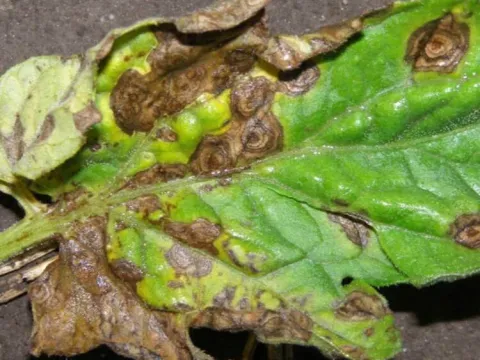
Beet leaf spot
Pleospora betae
Beet leaf spot is caused by the fungus Pleospora betae (the teleomorph stage), also known in its anamorph (conidial) stage as Phoma betae. It is a pathogenic ascomycete fungus belonging to the Dothideomycetes class, primarily affecting members of the Amaranthaceae family.
What the section contains
Beet leaf spot
Systematically, this pathogen belongs to the order Pleosporales. During its life cycle, the fungus develops pseudothecia, inside which ascospores mature, initiating primary infections at the beginning of the growing season.
The fungus produces septate mycelium capable of surviving for long periods in plant debris and infected seeds. Conidial fruiting bodies (pycnidia) form on necrotic plant tissues, facilitating secondary spread.
The pathogen is highly adaptable to various climatic conditions within beet-growing regions. The optimal temperature for mycelial growth ranges between +20°C and +25°C.
The primary inoculum reservoirs include infected seeds, soil containing crop residues, and beet stecklings, where the fungus can overwinter.
Sugar, table, and fodder beets are the primary hosts for this pathogen. The fungus impacts plants at all phenological stages: from seedlings to mature roots before harvest.
The disease contributes to "storage rot" (cagatt rot) in harvested roots, significantly reducing sugar content and raw material quality. In the field, it affects both vegetative parts and seed crops.
Seed infection leads to poor germination and seedling blight (damping-off), causing thin crop stands. In adult plants, the pathogen degrades foliage, reducing the photosynthetic capacity of the plant.
Infection spreads to petioles and the crown of the root, causing deep tissue decay. In seed-bearing plants, the fungus causes premature wilting and underdeveloped seeds.
Overall damage results in reduced root weight and sugar concentration, leading to substantial economic losses for agricultural producers.
Primary infection occurs in the spring when ascospores are disseminated by wind or rain splashes onto young seedlings. High humidity in both air and soil promotes rapid infection development.
Throughout the growing season, the fungus spreads via conidia, resulting in secondary infections on leaves. Warm and rainy weather typically triggers disease outbreaks in the second half of summer.
In the autumn, pathogen development continues on the petioles, from where the infection progresses to the root crown, preparing the groundwork for storage rot.
Pathogen spread is exacerbated by poor agronomic practices, specifically high plant density, which increases moisture retention in the root zone.
The infection risk increases when sugar beets are planted on the same field more frequently than every 3–4 years, as the fungal spores remain viable in the soil for extended periods.
In seedlings, the disease manifests as damping-off, where stems blacken, thin, and collapse. The root system often dies, leading to the rapid death of the plant.
On the leaves of mature plants, light brown spots with irregular or circular shapes and distinct margins appear. Over time, small dark dots — the fungus's pycnidia — develop in the center of these spots.
When petioles are affected, leaves yellow and die prematurely, starting from the lower canopy. In the root crown area, infected tissues become soft and dark in color.
On the cross-section of infected roots, darkening of the vascular bundles and tissue necrosis are observed. In storage facilities, affected areas are covered with a characteristic grey mold.
- Blackening and curling of seedlings;
- Characteristic leaf spots with pycnidia;
- Darkening and death of petioles;
- Root crown decay;
- Loss of marketability and storage shelf life.
The primary control measure for pleospora spot is the use of high-quality, disease-free seed material. Rigorous seed treatment with systemic fungicides that effectively suppress Phoma betae is essential.
Crop rotation is a critical factor; sugar beets should not return to the same field for at least four years to reduce soil-borne inoculum levels.
Deep autumn plowing is recommended to facilitate the rapid decomposition of plant residues, which serve as primary hosts for the pathogen.
During the growing season, if initial symptoms appear, fungicide applications based on azoles or strobilurins are required. Field monitoring is vital, especially during periods of wet weather.
Optimized mineral nutrition, particularly the application of potassium fertilizers, increases tissue resistance against pathogen penetration and improves overall plant health.