
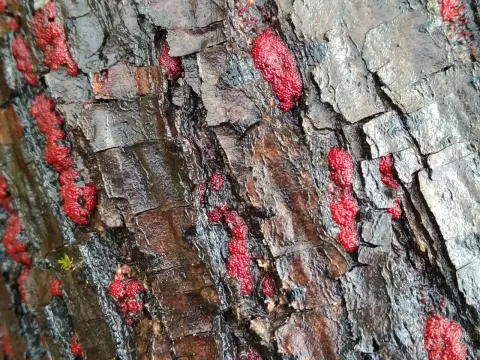
Coral spot
Nectria cinnabarina
Coral spot (Nectria cinnabarina) is a widespread fungal pathogen belonging to the Ascomycota division. It is primarily known as a weak parasite that exploits stressed or damaged woody plants, though it can survive as a saprotroph on dead wood.
What the section contains
Coral spot
The life cycle involves the production of distinct orange-pink or coral-red pustules on the bark, which release spores. Later in the cycle, the fungus develops dark red or black perithecia, which are small reproductive structures visible to the naked eye.
The fungus enters the plant through wounds, such as pruning cuts, frost cracks, or sites damaged by insect pests. Once inside, the mycelium colonizes the bark and cambium, effectively disrupting the tree's nutrient transport system.
Moisture is critical for the development and spread of Nectria cinnabarina. Rainy weather facilitates the movement of spores across the garden, allowing the fungus to infect new branches and vulnerable trees.
While often associated with deadwood, in cases of severe plant stress, the fungus can aggressively colonize healthy tissues, leading to systemic branch dieback.
Nectria cinnabarina causes significant damage, primarily manifesting as branch dieback and bark necrosis. It affects a wide range of deciduous trees and shrubs, including apple, pear, cherry, currants, and various ornamental maples.
The most severe impact is the girdling of stems or branches. Once the fungus encircles a branch, the parts above the infection point lose their connection to the roots and eventually die from dehydration and starvation.
In ornamental gardens, the infection can ruin the aesthetic appearance of shrubs and trees. In orchards, it reduces fruit yield and can lead to the loss of entire structural branches, weakening the tree's architecture.
Affected plants often show stunted growth and poor vitality. If left untreated, the fungus can progress from smaller branches to main limbs and eventually threaten the entire specimen.
The damage is particularly noticeable in crowded or poorly ventilated gardens, where high humidity allows the fungus to thrive and spread rapidly between closely planted hosts.
The most characteristic sign of the disease is the presence of bright pink or coral-red bumps, roughly the size of pinheads, erupting through the bark of dead or dying branches.
The affected bark typically becomes discolored, sunken, and often cracks. As the disease progresses, the pink pustules may darken into reddish-brown or black, harder structures.
Leaves on infected branches may wilt, turn yellow, or drop prematurely. Close inspection of the wood under the affected bark often reveals a dark, necrotic tissue patch that contrasts with the healthy wood.
In many cases, the death of a branch occurs suddenly after a period of favorable conditions for the fungus. The presence of these coral-like structures is a definitive identifier of the pathogen.
- Bright pink/coral pustules on the bark.
- Dieback of twigs and smaller branches.
- Sunken or cracked bark lesions.
- Yellowing and premature leaf fall.
- Visible dark perithecia in later stages.
The primary control strategy is the early detection and pruning of infected wood. All diseased branches should be removed well back into healthy tissue to ensure all latent mycelium is eliminated.
Tools used for pruning should be sanitized between cuts to prevent spreading the spores to healthy parts of the tree or to other plants in the garden.
Wounds larger than a certain diameter should be protected with a high-quality sealant or pruning paint to prevent spores from entering during the healing process.
Improving the plant's overall health through proper irrigation, mulching, and balanced fertilization increases natural resistance. Minimizing stress, such as protecting bark from sunscald, is also vital.
In orchards, regular fungicide sprays based on copper formulations can act as a preventative measure, specifically targeting the points of entry during the dormant or early spring season.