
Cordana johnstonii
Cordana johnstonii
Cordana johnstonii belongs to the kingdom Fungi, the division Ascomycota, and the class Dothideomycetes. This pathogenic micromycete primarily leads a parasitic lifestyle, affecting the foliage of tropical and subtropical plants.
What the section contains
Cordana johnstonii
The fungus forms a mycelium that penetrates the host tissue, causing localized necrotic changes. Sporulation occurs on the surface of infected tissues, where conidiophores and conidia are formed to ensure the dissemination of the infection.
Microscopic examination identifies Cordana johnstonii by the specific morphological features of its conidia. These are typically two-celled, pear-shaped or ellipsoidal, and dark-pigmented, which is characteristic of the Cordana genus.
The life cycle of the fungus is closely linked to moisture, which is necessary for spore germination and the development of new infectious structures. The pathogen can survive in plant debris, which acts as the primary inoculum source at the start of the growing season.
In a phytopathological context, this species is classified as a causal agent of leaf spot diseases, reducing the healthy leaf area and hindering the photosynthetic capacity of the affected plant.
The main crop susceptible to Cordana johnstonii is the banana (Musa spp.). The fungus causes a disease known as Cordana leaf spot, which is found in various tropical agricultural regions.
The disease affects both wild species and commercial banana cultivars. Under intensive cultivation conditions, the pathogen can strike plants at various growth stages, from young shoots to mature, fruit-bearing individuals.
Damage is manifested primarily on leaves, which is critical for a crop whose yield depends directly on the health of the foliage. Severe infections lead to premature drying of the leaves.
Beyond bananas, the potential host range may include other plants in the fungus's area of distribution. However, it is within banana plantations that Cordana johnstonii poses the greatest economic threat to growers.
The damage results not only in a reduction of fruit weight but also in an overall weakening of the plant's immunity, making it more vulnerable to secondary infections and pests.
The spread and development of the pathogen are most active under conditions of high humidity and moderately high temperatures, typical of tropical climates. The rainy season is a key driver of epiphytotics.
Fungal spores are easily transported by air currents, raindrops, and dew, allowing the infection to spread rapidly within the plantation. High planting density promotes stagnant air, creating a favorable microclimate for the fungus.
The start of the growing season is often marked by initial leaf infections from spores that survived in fallen plant debris. During warmer periods, the frequency of sporulation cycles increases, leading to an exponential rise in the number of infected plants.
Inadequate agronomic management, such as the failure to remove diseased foliage, leads to an accumulation of the inoculum background. Under favorable weather conditions, the disease can develop almost year-round.
The periodicity of symptom appearance correlates with the plant's active growth phases and changes in precipitation patterns that create the liquid water necessary for conidia germination.
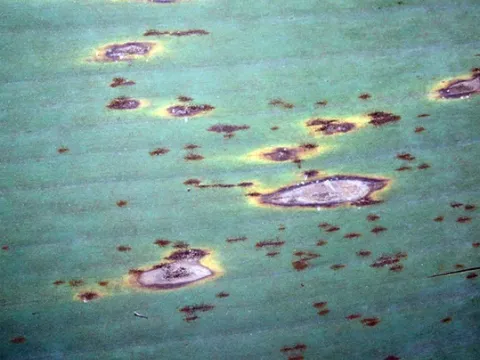
Key indicators of infection include necrotic spots on the leaves, which typically display an oval or elliptical shape. These spots often feature concentric zones reflecting the rhythmic growth of the fungal colony within the plant tissue.
A halo of chlorosis—yellowing of the tissue—is often observed around the spots, caused by toxins released by the pathogen during its metabolism. Over time, spots may coalesce, creating large necrotic areas.
In humid weather, a grayish or dark-brown coating can be seen on the underside of the leaves in the affected areas; this is the mass of fungal sporulation, which is the most reliable diagnostic sign.
In infected areas, the leaf tissue becomes brittle and may tear due to mechanical stress, such as strong winds. This leads to additional loss of the photosynthetic leaf surface.
Unlike some other leaf spot diseases, Cordana lesions have a specific coloration and configuration, allowing them to be distinguished from damage caused by other fungal agents during a detailed inspection.
The foundation of control is sanitary pruning and the removal of infected leaves from the plantation. It is essential not to leave plant debris behind, as it serves as a primary reservoir for the infection.
Optimizing planting density and improving plantation aeration help reduce humidity in the air layer near the ground, which significantly suppresses fungal development. Proper fertilization enhances the overall resistance of the plants.
The use of fungicides remains a necessary tool under high infection pressure. Recommendations include using copper-based products, as well as systemic fungicides from the triazole or strobilurin groups.
Adhering to crop rotation practices and using healthy planting material significantly reduce the risk of early disease outbreaks. Monitoring the plantation for early signs allows for the prompt containment of infection foci.
An integrated protection system includes a combination of cultural techniques and chemical treatments. Preventive spraying during periods of high humidity is the most effective control strategy.