
Monilinia fructicola
Monilinia fructicola
Monilinia fructicola is a destructive filamentous fungus belonging to the family Sclerotiniaceae. It is widely recognized as the primary causal agent of brown rot and blossom blight in stone fruit crops (Prunus species).
What the section contains
Monilinia fructicola
Taxonomically, it is classified within the phylum Ascomycota. This pathogen is highly specialized in its ability to infect fruits, blossoms, and shoots, making it a major concern for fruit producers worldwide due to significant post-harvest and pre-harvest losses.
The fungus reproduces primarily through conidia, which are disseminated by wind, water splashes, and insect vectors. It can persist in the environment for extended periods by forming dormant mycelium in infected tissues or mummified fruits.
The life cycle involves an overwintering stage in infected plant parts, where the fungus waits for favorable environmental conditions to trigger the production of new spores during the next growing season.
Under laboratory conditions, the fungus produces light-gray to buff-colored colony mats, and microscopic examination reveals branched conidial chains characteristic of the Monilia genus.
Monilinia fructicola primarily affects stone fruits such as peaches, nectarines, apricots, cherries, and plums. However, it can also infect pome fruits under specific conditions, causing significant economic damage.
The disease manifests in two main phases: the blossom blight phase, which results in the wilting and death of flowers and young twigs, and the fruit rot phase, which destroys ripening fruit.
Severe blossom blight reduces fruit set, which leads to a direct decrease in potential yield. The infection can spread from blossoms into spurs and branches, causing localized necrosis and twig dieback.
Fruit rot is often most destructive just before harvest. The fungus infects the fruit, causing rapid softening and browning, which renders the produce unmarketable and susceptible to further colonization by secondary pathogens.
In addition to field losses, the pathogen is a major cause of post-harvest decay during storage and transportation, as latent infections can manifest rapidly under cold storage conditions.
The disease cycle begins in early spring. Infected twigs and mummified fruits serve as primary inoculum. Conidia are released when temperatures are mild and moisture is available, infecting blossoms as they open.
As the season progresses toward harvest, the susceptibility of the fruit increases. Rainfall and high relative humidity during the weeks preceding harvest are the most critical factors for major disease outbreaks.
Optimal growth occurs at temperatures between 20°C and 25°C. High humidity levels combined with rain facilitate spore germination and infection, leading to rapid spread throughout the orchard.
In the autumn, the fungus prepares for winter. It colonizes the remaining fruit and necrotic branches, transforming them into mummies that contain the survival structures (mycelium) required to survive the dormant period.
Winter survival is highly efficient, as the mummified fruit can remain attached to the tree or fall to the ground, providing a constant source of infection for the subsequent year.
The first signs of infection in spring are the wilting and browning of blossoms. Infected petals may become covered with a fine, gray, powdery layer of fungal spores, and the infection may spread into the base of the flower.
Twigs affected by the disease develop sunken, elliptical lesions or cankers. In some cases, these cankers can girdle the twig, causing the death of the distal parts of the branch.
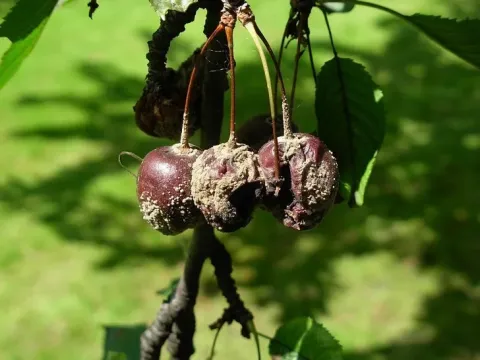
Fruit symptoms typically start as small, circular, dark-brown spots. These spots expand rapidly in moist conditions until they encompass the entire fruit, turning it into a soft, rotten mass.
A hallmark diagnostic feature is the appearance of gray or buff-colored tufts (conidial cushions) that develop on the surface of the rotted fruit, often arranged in distinct concentric circles.
Eventually, the fruit loses its water content, dries out, and hardens into a wrinkled, dark, and resilient "mummy" that remains on the tree or falls to the orchard floor.
Effective management of Monilinia fructicola requires an integrated approach that combines sanitation, cultural practices, and timely chemical interventions.
Sanitation is paramount: orchardists must remove and destroy all mummified fruits and prune out diseased twigs to eliminate the primary sources of inoculum before the next flowering season.
Chemical control programs involve the strategic application of fungicides during the bloom period and again pre-harvest. Rotation of different fungicide classes is essential to prevent the development of resistant fungal strains.
- Monitor and control insect pests that create entry wounds on fruit skin.
- Ensure proper orchard airflow through regular pruning to reduce humidity.
- Use fungicides during "pink bud" and full bloom stages.
- Implement post-harvest cooling to slow the growth of latent infections.
Ongoing research focuses on developing resistant cultivars and biological control agents to supplement traditional chemical methods and provide more sustainable solutions for the industry.