
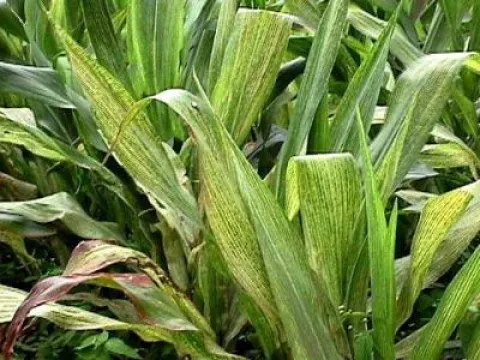
Maize streak virus
Maize streak
Maize streak virus (MSV) is a member of the Geminiviridae family and the Mastrevirus genus, containing a single-stranded DNA genome.
What the section contains
Maize streak virus
The virus is exclusively transmitted by leafhoppers of the genus Cicadulina, most notably Cicadulina mbila, which act as persistent vectors.
It cannot be transmitted through seeds, pollen, soil, or by physical contact between plants; it requires the insect vector for successful dissemination.
Once a leafhopper acquires the virus through feeding on an infected plant, it remains infectious for the remainder of its life cycle.
MSV is highly prevalent in tropical and subtropical climates, particularly across sub-Saharan Africa, where it causes significant economic losses.
The primary host is maize (Zea mays), although the virus also infects various grasses, including sorghum, pearl millet, sugarcane, and wheat.
The virus can persist in wild grass hosts throughout the year, facilitating its spread to newly planted maize crops in subsequent seasons.
Plants infected at an early seedling stage are most severely affected, often resulting in complete crop failure and substantial yield reduction.
The physiological impact includes reduced photosynthesis, stunted growth, and a drastic decline in grain yield due to impaired cob development.
The economic impact of the virus is severe, as it affects both subsistence farmers and large-scale commercial agricultural operations.
The most diagnostic symptom is the appearance of narrow, pale-yellow chlorotic stripes running parallel to the leaf veins.
As the disease progresses, these stripes may coalesce, leading to a general chlorotic appearance that significantly weakens the plant.
Stunting is a common characteristic; affected maize plants remain significantly shorter than healthy ones and exhibit reduced internode length.
Cobs produced by infected plants are often deformed, poorly filled, or completely empty, making them unsuitable for harvest.
Visual diagnosis is the standard in field conditions, though laboratory techniques like ELISA and PCR are used for confirmation in research settings.
The most effective management approach is the cultivation of maize varieties specifically bred for resistance or tolerance to the Maize streak virus.
Adjusting planting dates to avoid synchronizing the maize seedling stage with the peak population density of Cicadulina leafhoppers is highly recommended.
Cultural control includes the removal of grass weeds from field margins and surrounding areas to reduce the reservoir of the virus and the vector population.
Seed treatments with systemic insecticides can provide temporary protection to seedlings, minimizing the risk of early-season infection.
Maintaining high plant vigor through proper fertilization and irrigation helps plants better withstand the stress caused by the viral infection.