
Leucostoma canker
Leucostoma kunzei
The causal agent of Leucostoma canker is the fungus Leucostoma kunzei, an ascomycete that belongs to the Valsaceae family. It is a persistent pathogen commonly found in stone fruit orchards.
What the section contains
Leucostoma canker
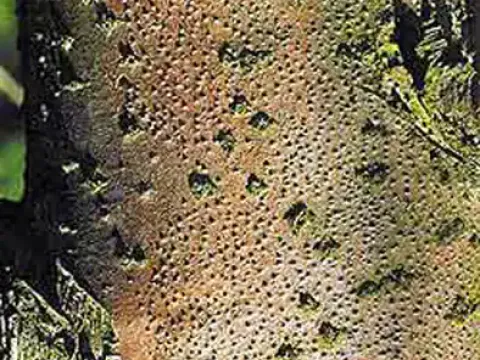
The fungus produces pycnidia, which are small black fruiting bodies that erupt through the tree bark. These release conidia during humid conditions, spreading the pathogen via rain splashes.
Leucostoma kunzei thrives by invading the cambium layer, effectively cutting off the nutrient supply line and causing local necrosis of the surrounding bark tissue.
Scientific classification identifies this pathogen as a wound parasite, meaning it requires existing damage to penetrate the bark surface of healthy host trees.
Molecular diagnostics and microscopic inspection of the pycnidia are essential for accurate identification, as symptoms often mimic other bark-inhabiting fungal infections.
This pathogen significantly affects stone fruits including peaches, apricots, cherries, and plums. It causes branch dieback and can eventually kill entire trees.
By girdling the limbs, the fungus stops the transport of water and nutrients, leading to the rapid yellowing and death of leaves distal to the site of infection.
Severe infections lead to heavy gummosis, which is the tree's attempt to seal the wound, though this often fails to stop the internal spread of the fungal mycelium.
The economic impact is substantial, involving the loss of scaffold branches, reduced yield, and the premature removal of infested orchard trees.
If left untreated, the disease progresses annually, gradually debilitating the tree until it becomes a reservoir of inoculum for neighboring healthy trees.
The fungus is active primarily during the spring season, as the rising temperatures and rainfall patterns coincide with the discharge of conidia.
During the summer months, the infection often remains latent or progresses slowly within the bark, waiting for environmental stress to weaken the host tree.
Autumn remains a high-risk period for infection, particularly through fresh harvest wounds and leaf scars, if weather conditions remain warm and moist.
Winter dormancy does not kill the pathogen; the mycelium survives in the infected bark tissues, remaining ready to produce new spores once spring arrives.
Wet weather, high humidity, and fog are the primary drivers of spore dispersal throughout the orchard, increasing the risk of widespread disease outbreaks.
The earliest symptom is the formation of small, discolored lesions on the bark, which later become depressed and appear sunken as the tissue dies.
Dark, pinhead-sized pycnidia appear scattered across the surface of the cankers, eventually rupturing the epidermis to release spore masses.
Heavy gummosis is a hallmark symptom, with amber-colored sap oozing from the margins of the cankers and down the surface of the trunk or branches.
Leaves on infected branches will exhibit chlorosis, curling, and wilting, often remaining attached to the branch even after the tissue has completely dried.
- Sunken, necrotic patches on the bark of trunks and limbs.
- Formation of perennial cankers with concentric growth rings.
- Exudation of gum from infected areas as a defense mechanism.
- Dieback of branches starting from the point of the canker.
Cultural practices are paramount, including proper pruning and fertilization to maintain high tree vigor, which helps trees resist fungal colonization.
Remove and destroy all infected branches during the dormant season, ensuring that cuts are made deep into healthy tissue to remove all signs of fungal growth.
Sanitize pruning tools with a bleach solution or alcohol between every cut to prevent mechanical transmission of the pathogen to healthy branches.
Apply copper-based fungicides during the dormant season to reduce the overall inoculum load on the bark surface and protect against new infections.
Protect tree trunks from sunscald by applying white latex paint, as sun-damaged bark is the most common entry point for Leucostoma kunzei.