
Leveillula taurica
Leveillula taurica
Leveillula taurica is an ascomycete fungus that causes a specific type of powdery mildew disease. It is a highly specialized endoparasite, distinct from other powdery mildews.
What the section contains
Leveillula taurica
Unlike most powdery mildews, the mycelium of L. taurica grows internally within the leaf tissue, penetrating through the stomata, which makes it an endophyte.
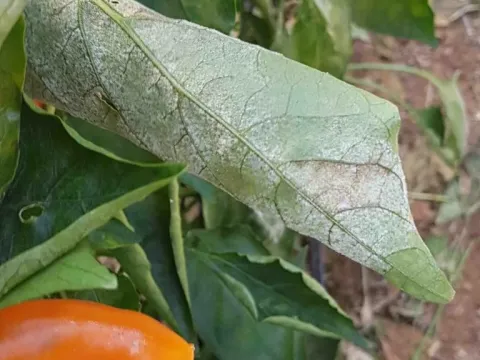
The fungus produces conidiophores that emerge through the stomatal openings, creating the characteristic white, powdery appearance on the surface of infected leaves.
Its sexual stage involves the production of cleistothecia, which serve as overwintering structures, containing asci and ascospores that initiate new infections.
The host range of L. taurica is extremely broad, affecting hundreds of plant species across diverse families including Solanaceae, Apiaceae, and Cucurbitaceae.
The primary damage caused by L. taurica involves the degradation of the photosynthetic capacity of the host plant, leading to stunted growth and reduced yields.
Infected leaves become chlorotic, wither, and drop prematurely, which exposes fruits to direct sunlight and increases the risk of sunscald.
The disease significantly impacts the quality of vegetables, often rendering produce unmarketable due to reduced size, poor color, and diminished nutritional value.
In severe cases of infestation, entire plantations of pepper, tomato, or eggplant can experience total collapse, resulting in massive economic losses for growers.
Because the fungus lives inside the host, the systemic damage is often irreversible, meaning that once the infection is established, eradication is extremely difficult.
Leveillula taurica thrives in warm, semi-arid climates, favoring temperatures between 20°C and 30°C, which distinguishes it from other powdery mildews.
The disease is most prevalent during late summer or early autumn when the daily temperature fluctuations allow for optimal spore germination and colonization.
While the fungus prefers dry conditions, it requires moderate humidity within the crop canopy to maintain the growth of its mycelial network.
In greenhouse environments, the pathogen can persist year-round if proper sanitation and climate control measures are not strictly enforced.
The dispersal of conidia is primarily wind-driven, allowing the pathogen to move rapidly across fields during periods of low precipitation.
Early symptoms appear as irregular, yellow or chlorotic spots on the upper leaf surface, often resembling a nutrient deficiency or common leaf blight.
As the disease progresses, a white, dusty fungal growth appears predominantly on the underside of the leaves, corresponding to the areas of chlorotic spotting.
Leaves eventually curl, turn necrotic, and detach from the plant, starting from the lower levels and progressing upwards through the canopy.
The absence of visible surface mildew on the upper leaf side can often lead to misdiagnosis, requiring careful inspection of the lower leaf surfaces.
- Chlorotic patches on the upper leaf surface.
- White, mycelial growth on the underside of leaves.
- Premature senescence and leaf abscission.
- Reduced fruit development and yield loss.
Cultural control practices, including the removal and destruction of crop residues, are essential to minimize the primary inoculum source for the next season.
Implementing crop rotation with non-host species and using resistant cultivars can help reduce the incidence of the disease in the field.
Chemical control should prioritize the use of systemic fungicides, specifically those that can penetrate leaf tissue to reach the internal mycelium of the pathogen.
Integrating biological control agents, such as specific mycoparasites, can provide suppression of the disease during early infection stages without heavy pesticide reliance.
Managing the greenhouse environment by optimizing ventilation and controlling humidity levels can significantly reduce the favorability of the microclimate for the fungus.