
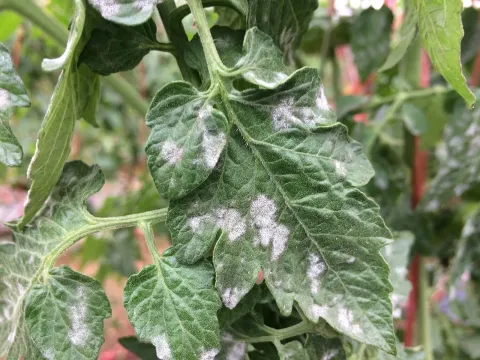
Leveillula mildew
Oidiopsis taurica
The causative agent of this disease is the fungus Leveillula taurica, belonging to the Kingdom Fungi, Phylum Ascomycota. Unlike other powdery mildew fungi, it is an endoparasite that colonizes the plant tissue internally.
What the section contains
Leveillula mildew
The fungus penetrates the host plant through the stomata and develops a mycelium within the leaf mesophyll. Only the conidiophores emerge through the stomata, forming the characteristic powdery appearance.
This species is highly specialized and belongs to the family Erysiphaceae. Its internal growth makes it significantly different from typical surface-dwelling powdery mildew pathogens.
The fungus is known for its ability to adapt to warm, arid environments, allowing it to thrive where other fungi might fail due to environmental stress.
Microscopic examination of the conidiophores and the way they emerge from the stomata is the standard method for confirming the presence of this specific pathogen in laboratory settings.
This pathogen has a wide host range, primarily infecting solanaceous crops such as tomatoes, peppers, and eggplants. It also affects onions, artichokes, and various ornamental plants.
Symptoms include yellowing and premature death of leaves, which leads to significant defoliation. As the infection progresses, the plant’s photosynthetic capacity is severely reduced.
Yield losses can be catastrophic, often ranging from 30 to over 50 percent, especially in commercial vegetable production where high plant density favors pathogen spread.
The damage caused by the fungus creates entry points for secondary pathogens, such as bacteria and other fungi, leading to post-harvest decay and reduced shelf life.
In greenhouses, Leveillula taurica is considered a major limiting factor, often requiring intensive management to maintain marketable quality of fruits and vegetables.
The pathogen thrives in warm temperatures, typically between 20 and 30 degrees Celsius. It is well-adapted to dry climates, which sets it apart from many other powdery mildew species.
Initial infection often originates from infected plant debris left in the soil or from weed hosts that survive throughout the winter in milder climates.
The conidia are wind-dispersed and do not require free water on the leaf surface to germinate, enabling rapid spread during dry, warm periods of the growing season.
Epidemics are most prevalent in the latter part of the season as the inoculum builds up in the environment and conditions become optimal for the fungal life cycle.
In greenhouse settings, if hygiene measures are not strictly followed, the fungus can complete its cycle continuously, persisting on crops throughout the entire year.
The initial signs are often subtle, characterized by yellow chlorotic spots on the upper leaf surface. These spots may mimic nutrient deficiencies, making early detection difficult.
As the disease progresses, these spots expand, often becoming necrotic and bounded by the leaf veins. Eventually, the affected leaves yellow and drop prematurely.
A faint white, dusty appearance on the underside of the leaves, consisting of emerging conidiophores, is the hallmark sign of the infection in later stages.
- Chlorotic spotting on upper leaf surfaces.
- Necrotic areas limited by major leaf veins.
- Severe defoliation starting from the lower canopy.
- Reduced fruit size and overall plant stunted growth.
Close inspection with a hand lens often reveals the fungal structures emerging specifically from the stomatal openings, distinguishing this from superficial powdery mildew.
Integrated management begins with strict sanitation, including the removal and destruction of crop residues to reduce the primary inoculum for the next season.
Crop rotation with non-host species is essential to break the life cycle of the pathogen and manage the soil-borne inoculum levels over time.
Chemical control involves the timely application of fungicides, particularly triazoles and strobilurins, rotated to prevent the development of resistant fungal populations.
Maintaining optimal greenhouse environmental conditions, including adequate ventilation and temperature control, can significantly suppress the rate of pathogen spread.
Biological control agents, such as formulations of Bacillus subtilis, can be used as a preventative measure to protect foliage from colonization in low-pressure scenarios.