
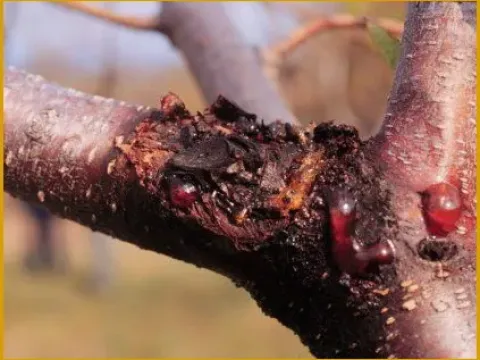
Leucostoma canker
Leucostoma cincta
Leucostoma canker is a destructive fungal disease affecting woody plants, caused by the ascomycete fungus Leucostoma cincta.
What the section contains
Leucostoma canker
The pathogen is a weak parasite that infects trees through wounds, frost cracks, and pruning sites, thriving in compromised plant tissue.
Its biological cycle is characterized by the production of pycnidia and perithecia, which act as primary sources of inoculum throughout the growing season.
Fungal spores are disseminated by rain splashes, wind currents, and mechanical transmission through contaminated pruning tools.
The fungus overwinters as mycelium within the bark and sapwood of infected host plants, ready to resume activity during warmer periods.
The disease primarily attacks stone fruit species, with apricot, peach, cherry, and plum being the most susceptible varieties.
It causes the death of the cambium layer, leading to the formation of sunken cankers that eventually girdle limbs and trunks.
Infection results in branch dieback, significant reduction in crop yield, and the eventual death of the affected fruit tree.
The presence of the fungus weakens the tree's physiological structure, making it more prone to secondary wood-rotting pathogens and environmental stress.
The economic impact is high, as the infection often necessitates the removal and replacement of mature trees in commercial orchards.
Typical symptoms include the development of depressed, brownish lesions on the bark, which expand over time to encircle the branch.
Gummosis is a hallmark sign, where the tree exudes sticky amber-colored sap from the canker sites in an attempt to isolate the infection.
Small pimple-like structures, known as pycnidia, erupt through the bark surface, releasing spores in distinctive yellow or orange tendrils under moist conditions.
Foliage on infected branches wilts, turns yellow or brown, and dries out, often remaining attached to the dead branch for an extended period.
Internally, the tissue underneath the affected bark exhibits a dark, necrotic appearance, indicating the deep progression of the mycelial growth.
Sanitation is the cornerstone of control; all infected branches must be pruned back to healthy wood, with tools disinfected after every cut.
All pruning wounds and mechanical injuries should be protected with appropriate wound sealants or protective paints to prevent spore entry.
Applying copper-based fungicides during the dormant period is critical for reducing the surface spore load on bark and preventing new infections.
Maintaining tree health through proper fertilization and irrigation is essential to improve the tree's natural defense mechanisms against the pathogen.
Preventative measures against winter injuries, such as applying trunk white-wash, significantly reduce the sites of entry for Leucostoma cincta.