
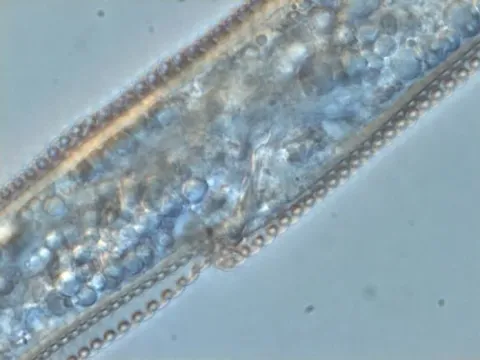
Hemicycliophora vaccinium
Hemicycliophora vaccinium
Hemicycliophora vaccinium is a species of plant-parasitic nematode belonging to the family Hemicycliophoridae. It is a microscopic, ectoparasitic organism living in the rhizosphere of host plants.
What the section contains
Hemicycliophora vaccinium
The nematode is characterized by a distinctive cuticle with heavy annulation, which gives it a ringed appearance. Adults possess a long, flexible stylet used for feeding on plant root cells.
Its life cycle involves an egg stage, four larval stages, and an adult stage. The transition between stages requires regular molting, often resulting in a protective exuvium.
This nematode thrives in moist soil conditions, positioning itself near the root tips to feed. It is highly sensitive to soil temperature and moisture fluctuations in its immediate micro-environment.
Due to its microscopic size, precise identification requires laboratory extraction techniques, such as the Baermann funnel method or specific sieve processing.
The primary hosts of Hemicycliophora vaccinium are plants in the Vaccinium genus, most notably highbush blueberries, where it targets the tender root tissues.
By feeding on the epidermal cells of root tips, the nematode induces the formation of galls and localized lesions, disrupting the normal anatomical development of the roots.
This damage severely impairs the root system's efficiency in taking up water and essential nutrients, leading to physiological stress within the plant.
Secondary infections by soil-borne fungi are more likely to occur in areas where the nematode has wounded the roots, compounding the primary damage.
Economic damage manifests as reduced plant vigor, stunted growth, and significantly lower fruit yields, ultimately reducing the commercial lifespan of the plantation.
Visible symptoms often appear as localized patches of stunted or chlorotic plants, which may initially be mistaken for nutrient deficiencies or water stress.
Affected blueberry bushes exhibit reduced shoot length and sparse foliage compared to healthy plants, reflecting the underlying damage to the root network.
During the growing season, infected plants show poor tolerance to heat and drought, with leaves drooping or wilting prematurely under moderate stress conditions.
When examining the root system, one may observe a reduction in the density of fine, white feeder roots and the presence of localized root tip deformations.
Over time, the affected areas expand as the nematode population spreads, leading to a general decline in the health and productivity of the entire block of plants.
The most reliable control strategy is the use of certified, nematode-free nursery stock to prevent the introduction of the parasite into new production areas.
Pre-planting soil testing is essential to assess nematode populations and ensure that sites are suitable for planting, avoiding areas with high initial infestation levels.
Good agricultural practices, such as maintaining optimal soil organic matter and managing irrigation, can help boost plant resilience against minor infestations.
Sanitation of tools and farm machinery is critical, as soil containing nematodes can easily be transferred between fields on boots, tires, and cultivation equipment.
While chemical nematicides exist, their application is strictly regulated and should only be used as a last resort within an integrated pest management program.