
Hemp mosaic
Hemp mosaic
Hemp mosaic is a viral disease caused by specific pathogens that infect Cannabis sativa. Systematically, the causative agent belongs to a group of viruses transmitted primarily through mechanical means or insect vectors.
What the section contains
Hemp mosaic
The virus affects the plant's cellular metabolism, disrupting photosynthesis and chlorophyll synthesis. This leads to characteristic changes in the pigmentation of leaf and stem tissues.
The infection is characterized by systemic spread throughout the entire plant organism. Upon entering the vascular system, the virus quickly reaches growth points and young shoots.
Unlike fungal diseases, the mosaic virus does not form external coatings or spores. Its presence is determined solely by the deformation and discoloration of plant tissues.
For accurate identification in professional laboratories, methods such as ELISA (enzyme-linked immunosorbent assay) or PCR diagnostics are used to detect the presence of viral proteins or nucleic acids.
The primary host is industrial hemp (Cannabis sativa). The disease can affect both technical varieties and other cultivars of this species.
Infection leads to a significant decrease in total plant biomass. Affected individuals show stunted growth and development of vegetative mass.
The virus negatively impacts the quality of fiber in technical varieties. The fiber becomes brittle, less elastic, and loses its commercial properties, which reduces crop profitability.
When seed crops are infected, seed yield and germination rates decrease. This creates risks for the reproduction of the crop in subsequent seasons.
Overall plantation productivity falls in proportion to the level of virus spread. In epiphytotic years, losses can reach significant levels, jeopardizing production profitability.
The virus's life cycle is closely linked to the activity of insect vectors, particularly various aphid species, which are the main infection vectors in field conditions.
Primary infection centers often emerge at the beginning of the growing season when pest populations begin to actively colonize young hemp seedlings.
The spread of the disease continues throughout the summer. Favorable conditions for a virus outbreak include warm weather and the presence of weeds that serve as infection reservoirs.
The virus can persist in overwintering perennial weeds or be transported via infected plant material. Mechanical transmission through tools during agronomic practices also plays a major role.
Secondary infections occur as a result of insect movement within the fields. The higher the planting density and the number of pests, the faster the virus spreads across the plantation.
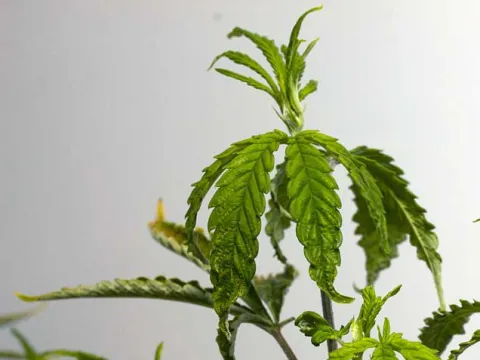
The main sign of infection is the appearance of mottled coloration on leaves, known as mosaic patterns. The alternation of light green and dark green areas creates a characteristic appearance.
Deformation of leaf blades is observed; they may become crinkled or curled at the edges. Leaf margins often take on an uneven, serrated shape.
Plants infected at an early age lag significantly in growth, appearing stunted. Internodes in such individuals are shortened, and the stem becomes thin and weak.
- Yellowing of leaf veins (chlorosis).
- Loss of leaf blade symmetry.
- Reduced intensity of green coloration (paleness).
- General retardation of reproductive organ development.
In some cases, necrotic spots may appear on stems, indicating deep damage to the plant's vascular system by the virus.
A key protection method is the control of insect vectors (aphids and thrips). The use of systemic insecticides helps reduce the risk of virus spread during early growth stages.
It is necessary to strictly maintain spatial isolation between hemp crops and other plants that may act as hosts for these viruses.
An important control step is timely weeding. Eliminating vegetation on field edges denies the virus «bridges» for overwintering and vector reproduction.
It is recommended to use only certified seed material that is free of viral infections. Upon detection of the first signs of disease, affected specimens must be immediately removed from the field and destroyed.
Tools used for crop maintenance must be regularly disinfected to prevent mechanical transmission of viral particles between plants.