
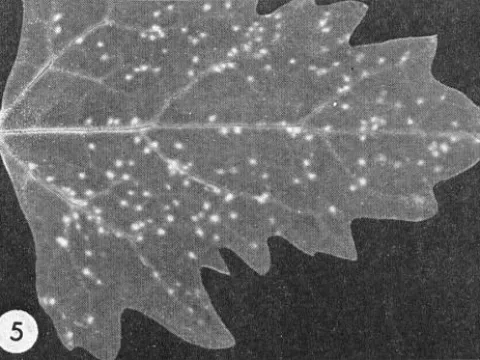
Henbane mosaic
Henbane mosaic
The causative agent of the disease is the Henbane mosaic virus (HMV), a member of the Potyvirus genus within the Potyviridae family. It is a single-stranded RNA phytopathogenic virus that infects a wide range of cultivated and wild plants in the Solanaceae family.
What the section contains
Henbane mosaic
The virus consists of filamentous flexible particles approximately 700–800 nm long. It exhibits a high degree of variability, which complicates the breeding of resistant crop varieties.
The primary method of identification in the field is visual inspection; however, accurate identification of the virus species requires laboratory diagnostic tests such as Enzyme-Linked Immunosorbent Assay (ELISA) or PCR analysis.
Systematically, the virus is closely related to other members of the potato Y-virus group, which accounts for the similarity in their epiphytotic patterns and transmission mechanisms in agroecosystems.
The pathogen persists in perennial weeds of the nightshade family, which serve as a primary reservoir of infection at the beginning of the growing season.
Henbane mosaic virus primarily affects members of the Solanaceae family. At-risk crops include potatoes, tomatoes, peppers, eggplants, and the medicinal plant black henbane.
The virus can infect ornamental plant species, which act as latent carriers and contribute to the accumulation of infection pressure in the field.
The damage manifests as a suppression of photosynthetic and respiratory physiological processes, leading to a significant loss of market quality and reduced overall yield.
Affected plants experience slowed growth and impaired development of reproductive organs, which often leads to premature shedding of flowers or fruit sets, especially under stressful weather conditions.
In some cases, the infection results in the deformation of fruits and tubers, rendering them unsuitable for long-term storage or commercial sale.
The infection cycle begins in spring, when the virus is transmitted from overwintering sources to young host plants by insect vectors.
The primary vectors of the virus are various aphid species, which transmit the virus particles in a non-persistent manner—the virus persists in the insect's mouthparts only briefly.
Active spread of the disease occurs during periods of massive aphid flights, which often correlates with warm and moderately humid weather conditions in mid-summer.
Secondary infection occurs throughout the growing season as winged aphids move from infected plants to healthy ones within the field or to neighboring plots.
The development of epiphytotics is facilitated by high planting density and the lack of measures to control weed vegetation along the perimeter of agricultural fields.
The most characteristic symptom is the emergence of a mosaic pattern on the leaves, manifesting as alternating light green and dark green patches.
Deformation of the leaf blade is frequently observed, often accompanied by curling of the edges or crinkling, which drastically reduces the assimilation surface area.
- Vein yellowing (chlorosis).
- Presence of necrotic spots or streaks on stems.
- Stunting and general growth retardation of the plant.
- Reduced fruit weight and impaired organoleptic qualities.
In cases of early infection, plants appear chlorotic and their development effectively halts, leading to plant death or complete sterility of the flowers.
Symptoms can vary depending on the plant variety, age of infection, and environmental conditions, sometimes appearing in a latent (hidden) form.
The protection strategy is based on the use of virus-free seed material and the cultivation of resistant varieties, where available in the region.
Regular aphid control using insecticides is necessary to reduce the level of secondary infection spread within crops.
The most important agrotechnical measure is the eradication of infection reservoirs—specifically, perennial nightshade weeds like henbane and black nightshade.
It is recommended to maintain spatial isolation between new plantings and older plots where viral diseases have previously been detected.
During plant care, mechanical damage should be avoided, as the virus can be transmitted through contact during pruning, pinching, or harvesting.