
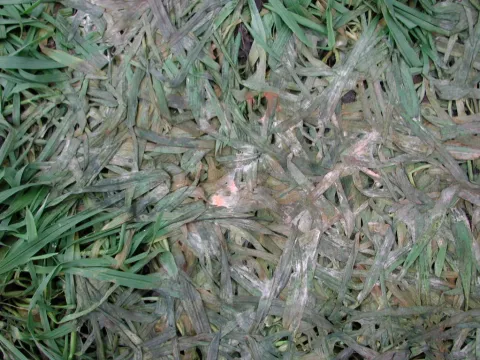
Fusarium snow mold
Fusarium nivale
The causative agent of snow mold is the fungus Microdochium nivale (formerly known as Fusarium nivale), a member of the kingdom Fungi, phylum Ascomycota. It is a psychrophilic pathogen specialized in attacking cereals and grasses at low temperatures.
What the section contains
Fusarium snow mold
The fungus survives in soil and crop debris as mycelium or spores. It thrives in cool, wet environments, particularly during winter months when fields are covered by a thick snow layer that acts as an insulator for the pathogen.
The life cycle involves infection of young seedlings or overwintering plants during late autumn and early spring. The fungus requires high humidity and temperatures between 0°C and 10°C to colonize host tissues effectively.
Infection is spread via contaminated seed, soil movement, and water runoff. Because it is highly adapted to cold, it can persist even in regions with very long and harsh winters, causing significant damage under the snowpack.
Microdochium nivale is known for its ability to remain dormant during hot summer periods, only to reactivate as soon as temperatures drop and the first autumn frosts and subsequent snow accumulation occur.
The disease primarily affects winter wheat, winter rye, barley, and various perennial grasses. Both seedling stages and tillering plants are highly susceptible to infection, leading to stand reduction.
Damage occurs primarily in the root zone and the crown of the plant. Once the crown is infected, the entire plant often dies, leading to patchy fields that require expensive overseeding or complete crop destruction.
The economic impact is substantial due to crop failure and the loss of winter hardiness. Plants that are weakened by the fungus cannot survive the final stages of winter, leading to lower yields and uneven crop stands.
Mycotoxins produced by the pathogen can affect plant metabolism and lead to stunted growth. This physiological stress reduces the plant's ability to recover during the following spring, even if it manages to survive.
Secondary infections often take hold in plants weakened by snow mold, further compounding the issue and making the recovery process difficult for the farmer to manage effectively in the spring.
The most distinctive sign is the appearance of white to pinkish mycelium patches on the leaves immediately after the snow melts in the spring. This mycelial growth often forms a web-like covering over the infected leaves.
Infected leaves lose color, turn necrotic, and eventually rot. As the disease progresses, the patches of mold enlarge, and the infected tissues become soft and brittle, leading to the collapse of the plant canopy.
Upon closer inspection, small reproductive structures (sporodochia) can be seen on the affected tissues. These spores are responsible for the further spread of the disease within the field under favorable weather conditions.
- White or pinkish fungal mycelium mats.
- Matted and water-soaked leaf tissues.
- Crown rot and discoloration of the stem base.
- Irregular patches of missing or dead plants.
- Slow regrowth or chlorosis during the spring.
The pattern of infection is usually patchy, corresponding to the thickness and duration of the snow cover. Micro-depressions in the field where snow accumulates for longer periods are typically the primary sites for outbreaks.
The most effective strategy is the use of high-quality, treated seeds. Fungicidal seed treatment protects the young seedling during the critical germination and tillering phases from soil-borne pathogens.
Good agricultural practices are essential, including the timely sowing of winter crops. Avoiding early planting prevents plants from becoming too large and succulent, which makes them more attractive to the fungus.
Soil nutrient management is crucial; avoiding excessive nitrogen fertilization in late autumn prevents over-growth of vegetative tissues. Balanced fertilization, especially with phosphorus and potassium, enhances winter hardiness.
Deep plowing and proper crop rotation help to bury infected residues, reducing the fungal inoculum levels in the soil for future seasons. This practice limits the amount of fungus available to initiate new infections.
In severe cases, application of contact or systemic fungicides in early spring may be necessary to stop the spread of mycelium to healthy, adjacent plants, provided the weather conditions are favorable for treatment.