
Dryad's saddle
Polyporus squamosus
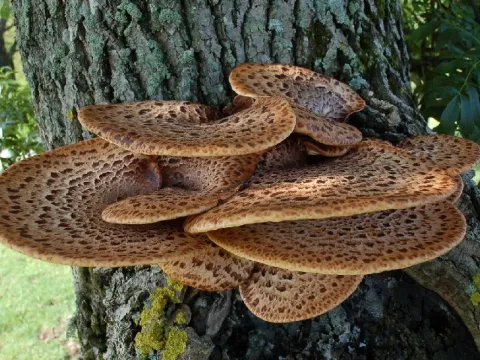
Dryad's saddle (Latin: Polyporus squamosus) is a basidiomycete fungus belonging to the Polyporaceae family. It is a wood-decay fungus that acts as a facultative parasite, primarily attacking weakened or damaged hardwood trees.
What the section contains
Dryad's saddle
The fruiting bodies are easily identified by their fan-shaped caps covered in large, dark brown scales on a light-colored surface. The mycelium aggressively colonizes the inner wood, leading to structural degradation.
This pathogen affects a wide range of broad-leaved trees, including maple, elm, walnut, and various fruit trees like apple and pear. It exploits existing wounds on the tree trunk or large branches to establish its infection.
The fungus causes a white heart rot, which significantly compromises the structural integrity of the wood. As the lignin is broken down, the tree becomes prone to windthrow and limb breakage, often posing a hazard in orchards and parks.
The life cycle begins when airborne spores land on exposed wood tissue from wounds or pruning cuts. The infection process is most active during the spring and early summer when humidity levels favor spore germination.
Fruiting bodies typically appear in late spring. After releasing millions of spores, the mushrooms decay, but the internal mycelium remains dormant during winter and resumes its destructive growth the following spring.
The most visible symptom is the presence of the mushroom's fruiting bodies attached to the trunk. These are usually found in clusters and have a distinct appearance due to their brown scales and large size.
- large, fan-shaped mushrooms with dark scales on the upper side;
- soft, spongy white rot within the wood layers;
- darkening or discoloration of the trunk bark near the infection point;
- wilting foliage on branches directly connected to the decayed area;
- the formation of hollows within the main stem of the tree.
Management of this fungus focuses on orchard sanitation. Infected branches must be pruned back to healthy wood, and tools should be sterilized between cuts to prevent transferring spores to healthy trees.
Proper wound care is essential for prevention. All major pruning cuts and mechanical injuries to the bark must be sealed with appropriate fungicides or wound dressings to prevent the initial colonization by Polyporus squamosus spores.