
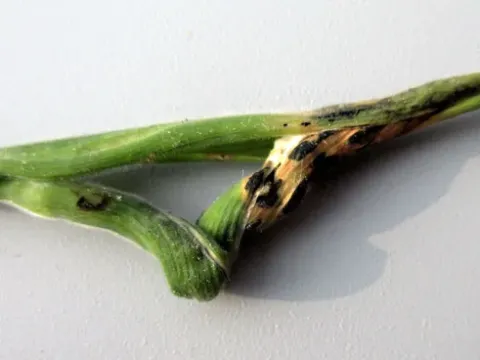
Dilophospora leaf spot
Dilophospora alopecuri
Dilophospora alopecuri is a fungal pathogen belonging to the order Dothideales. It is a well-known pathogen that frequently operates in conjunction with the seed gall nematode Anguina tritici.
What the section contains
Dilophospora leaf spot
The fungus produces pycnidia, which are specialized reproductive structures. Inside these pycnidia, conidia are formed, characterized by distinct thread-like appendages at both ends of the spores.
This fungus is a necrotrophic parasite that colonizes the tissues of the host plant, often causing systemic infection throughout the stem and the floral structures.
It is known to persist in soil, crop residues, and infected seeds for extended periods, making it a persistent threat in agricultural fields where it has been established.
Microscopic identification of the conidia, combined with observation of the characteristic symptoms, is the standard approach for confirming the presence of this pathogen in field samples.
The host range includes several important cereal crops, most notably wheat (Triticum aestivum), rye, and various grass species like foxtail and bentgrass.
The damage is systemic; the pathogen causes significant distortion, twisting, and thickening of the stems, which prevents normal development of the plant.
In the head of the plant, the fungus prevents the formation of grain. Instead, the spikelets become filled with a mass of fungal tissue, resulting in yield losses that can reach significant levels in heavily infested fields.
Beyond the loss of grain yield, the infection renders the straw brittle and contaminated, which makes it unsuitable for livestock bedding or fodder production.
Economic losses are exacerbated by the fact that the presence of infected grain requires costly cleaning processes and can lead to the rejection of the harvest at grain elevators.
The earliest symptoms appear during the stem elongation phase, manifesting as elongated dark spots on the leaf blades that gradually expand and merge.
Stems exhibit darkening and longitudinal black streaks caused by the eruption of fungal pycnidia through the epidermis of the plant tissue.
Deformation of the ear is the most diagnostic sign of the disease. The affected ears appear stunted, twisted, and often blackish in color due to the dense accumulation of fungal spores.
Infection usually occurs in patches within the field, reflecting the distribution pattern of the nematode vector that helps the fungus penetrate the plant's natural barriers.
The combination of twisted stems and deformed, blackened ears is a strong indicator of the presence of the Dilophospora-Anguina complex in the crop.
Preventative measures are the most effective strategy. The use of certified, clean seed that is free from nematode galls is essential to break the infection cycle.
Implementing a proper crop rotation system is crucial. Rotating wheat with non-host crops for at least two years significantly reduces the population of the nematode vector and the soil-borne fungal inoculum.
Sanitation practices, such as deep plowing, help bury crop residues, which hastens the decomposition of infected tissues and reduces the survival of the pathogen.
Effective weed management, particularly the removal of wild grasses that act as alternative hosts, prevents the survival of the pathogen during the off-season.
Seed treatments using registered fungicides can protect seedlings from early-stage infection, although they do not provide total immunity once the plant is established in the field.