
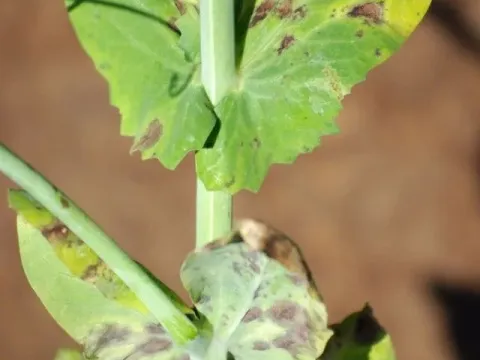
Chickpea ascochyta blight
Didymella rabiei
Chickpea ascochyta blight is a severe fungal disease caused by the pathogen Didymella rabiei (anamorph Ascochyta rabiei). It belongs to the phylum Ascomycota and is a highly specialized parasite that exclusively affects chickpea crops worldwide.
What the section contains
Chickpea ascochyta blight
The fungus survives between seasons as mycelium and pycnidia on infected crop debris and in seeds. It can persist in the soil for up to two years, making crop rotation a critical component of disease management.
The disease cycle involves both asexual reproduction (pycnidia with pycnidiospores) and sexual reproduction (perithecia with ascospores). Ascospores are airborne and can travel long distances, leading to widespread infection.
Development is favored by cool to moderate temperatures (15–25 °C) and high humidity. Rain splashes and wind-borne spores effectively spread the pathogen throughout the field during the growing season.
Infection occurs through stomata or mechanical wounds on the plant surface. Once inside, the fungus secretes cell-wall-degrading enzymes and toxic metabolites, leading to rapid tissue death and the characteristic necrotic spots.
The pathogen attacks all aerial parts of the plant, including leaves, stems, flowers, and pods. If the infection occurs at the seedling stage, it can cause severe stand loss and even complete crop failure.
On stems, the fungus creates girdling lesions that weaken the structure, often leading to stem breakage and lodging. This disrupts the plant's vascular system, preventing nutrient transport and causing wilting.
When pods are infected, the fungus penetrates inside, causing seed discoloration and shriveling. Infected seeds exhibit reduced germination rates and serve as the primary inoculum source for subsequent seasons.
The economic impact of ascochyta blight is substantial; in favorable conditions, yield losses can range from 50% to 100%. The quality of the harvested grain is severely degraded, making it unsuitable for commercial use.
Beyond direct yield reduction, the disease severely weakens the plant, making it more susceptible to environmental stress and secondary infections. Early-season epidemics can devastate entire fields within a very short period.
Early symptoms appear as circular or oval gray-brown spots with a dark brown margin on the leaves. Over time, small black fruiting bodies called pycnidia develop in the center of these spots.
Stem lesions are usually elongated and become sunken, appearing as necrotic cankers. These cankers often cause the stem to bend or snap, which is a definitive sign of the disease progression.
In humid conditions, a dark-colored fungal mat (spore mass) may cover the lesions. Leaves typically turn yellow, curl up, and drop prematurely, leading to significant defoliation of the crop.
Pods show dark, often concentric spots. If the infection reaches the seeds inside, they appear dark, wrinkled, or marked with necrotic lesions, often with fungal growth visible on the seed coat.
- Circular spots with dark brown margins.
- Black pycnidia in the center of necrotic lesions.
- Sunken stem cankers leading to breakage.
- Premature leaf yellowing and shedding.
- Discolored and deformed seeds within infected pods.
The primary control measure is the use of pathogen-free, certified seeds. Treating seeds with systemic fungicides is essential to suppress early-season infection and protect young seedlings.
Implementing a strict crop rotation schedule, avoiding chickpeas on the same field for at least 3–4 years, is crucial. This helps significantly reduce the primary inoculum load in the field.
Deep plowing of crop residues helps to bury and decompose infected stubble, accelerating the breakdown of fungal pycnidia. Effective management also includes the removal of volunteer chickpea plants.
During the growing season, regular scouting is necessary. If the disease appears, foliar application of appropriate systemic fungicides should be initiated immediately to prevent the spread of the fungus.
Breeding and utilizing resistant or tolerant chickpea cultivars is the most sustainable long-term strategy. Resistant varieties significantly reduce the need for chemical interventions and protect yield stability.