
Cranberry fruit rot
Monilinia oxycocci
Monilinia oxycocci is a pathogenic fungus belonging to the genus Monilinia, within the kingdom Fungi. It is classified as an ascomycete specifically adapted to parasitize cranberry plants.
What the section contains
Cranberry fruit rot
The pathogen has a complex life cycle involving a dormant phase as sclerotia, which overwinter in mummified berries on the ground. In spring, these sclerotia produce apothecia when environmental conditions are right.
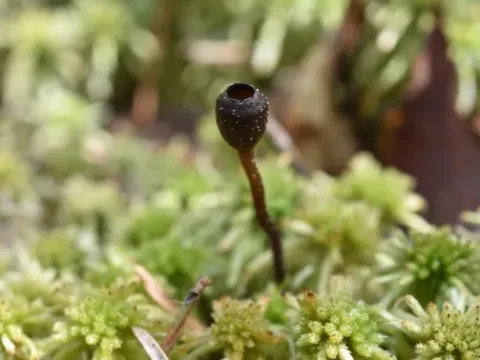
Apothecia are small, cup-shaped fungal structures on stalks that actively discharge ascospores. These spores serve as the primary source of infection for young cranberry shoots and flowers at the beginning of the season.
The fungal mycelium spreads through plant tissues, invading the vascular system of the shoots. Later, conidial sporulation occurs on the affected areas, providing secondary infection throughout the growing season.
The fungus is highly host-specific, primarily affecting Vaccinium macrocarpon (American cranberry) and Vaccinium oxycoccos, making it a significant concern for commercial berry growers.
The pathogen infects almost all aerial parts of the plant: young shoots, flowers, and developing berries. Early symptoms include the infection of stem tips, causing distortion and dieback.
The most significant economic damage occurs during the flowering and fruit-set stages. Infection of blossoms leads to complete wilting and abscission, drastically reducing the plantation's yield.
Berries infected by Monilinia oxycocci become mummified. The fungus replaces the internal tissues of the berry, turning it into a dry, hard shell containing a sclerotium.
Damage results not only in direct crop loss but also in the buildup of disease inoculum in the field. Massive infections can lead to losses of 30–50% of the yield in favorable years.
Infected areas act as disease reservoirs for future seasons, complicating field management and increasing the need for fungicide applications.
Disease development begins in early spring, immediately after snowmelt and the return of warmer temperatures. The peak activity of apothecia coincides with the bud break and early shoot growth of cranberries.
Cool, wet weather during the bloom period is a critical factor for widespread infection. During this time, spores germinate most effectively on the surfaces of young, susceptible plant tissues.
Secondary infections of the fruit occur during the summer. Conidia produced on infected shoots are dispersed by wind and rain splashes to developing ovaries, where the fungus continues to grow until fruit maturation.
In autumn, the life cycle completes as the pathogen enters the sclerotium stage. The mummified berries fall to the soil, where they overwinter, awaiting the next growing season to reactivate.
Understanding the phenological stages of cranberry development is essential for timing control measures to interrupt the infection cycle at the most vulnerable moments for the plant.
The first sign of spring infection is a characteristic grayish spore-bearing mold on shoot tips. Affected tips often curl, forming the classic "shepherd’s crook" shape.
Infected flowers lose turgor, darken, and wilt rapidly. Under magnification, small, dusty-looking sporulation tufts can be seen on these blossoms.
Infected ovaries cease development. As they mature, they turn an atypical beige or light brown color, becoming hard and dry, eventually transforming into shriveled "mummies".
A definitive diagnostic feature is the presence of a hard, dark sclerotium inside or on the surface of these mummified berries, which serves as a reliable marker in the field.
In severe cases, the entire plantation may appear "scorched," with shoots appearing wilted and foliage potentially yellowing or turning brown prematurely.
Sanitation is the cornerstone of control. Meticulous removal and destruction of infected plant debris, especially mummified berries, significantly reduces the primary inoculum level.
Fungicide application is a necessary component of intensive cranberry cultivation. Preventive sprays are recommended during the early growth phase and at the bud stage.
Creating conditions that promote good air circulation is vital. High humidity within the crop canopy favors spore development, so growers should avoid excessive planting density.
Sand mulching helps to "bury" the sclerotia, preventing the discharge of ascospores in the spring. A 2–3 cm layer of sand acts as an effective physical barrier against infection.
Regular field monitoring during the bloom period allows for early detection of initial symptoms, enabling targeted spot treatments to prevent an epidemic across the entire plantation.