
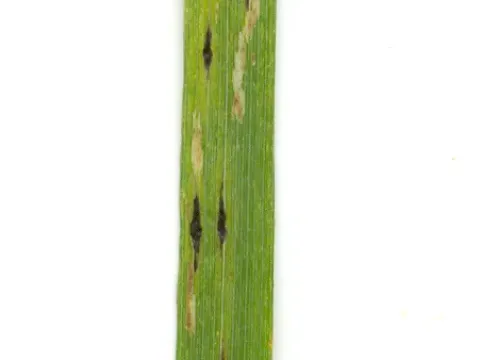
Rice cercospora leaf spot
Cercospora oryzae
The causative agent of rice narrow brown leaf spot is the fungus Cercospora oryzae (synonym Sphaerulina oryzina), belonging to the kingdom Fungi, phylum Ascomycota. This pathogen is highly specialized and infects primarily rice plants.
What the section contains
Rice cercospora leaf spot
The fungus overwinters as mycelium and conidia on infected plant debris, in the soil, and on seeds. In spring, when environmental conditions become favorable, spores are disseminated by wind and rain splashes onto emerging seedlings, initiating the infection.
The development cycle involves spore germination followed by hyphal penetration into leaf tissues through stomata or directly through the epidermis. Under favorable conditions, the cycle repeats multiple times during the growing season.
The fungus thrives in warm and humid climates, with optimal temperatures for conidial germination ranging from 20°C to 30°C. High relative humidity is essential for mass spore production and spread across the field.
The pathogen is known for its persistence, capable of surviving in infested crop residues for long periods. This makes crop rotation and field sanitation critical components of any effective disease management strategy.
Rice cercospora leaf spot mainly affects leaf blades, leaf sheaths, and occasionally the panicles. By causing necrotic lesions, the disease significantly reduces the total photosynthetic surface area of the rice plant.
The damage disrupts essential physiological processes such as transpiration and gas exchange, leading to premature leaf senescence and death. This is particularly devastating if infection peaks during the critical grain-filling stage.
The economic impact manifests as a reduction in grain yield, lower test weights, and poor grain quality. Heavy infections can lead to significant yield losses, potentially reaching 20% to 40% in highly susceptible rice varieties.
Beyond yield reduction, the disease affects the structural integrity of the plant. Weakened leaf sheaths and stems increase the risk of lodging, which complicates harvesting and further increases losses due to reduced recovery of the crop.
Seeds harvested from heavily infected crops may carry the pathogen, leading to poor germination rates and stunted seedlings in the subsequent season, thus propagating the cycle of disease in new planting areas.
Initial symptoms consist of narrow, linear, reddish-brown to dark-brown lesions that develop parallel to the leaf veins. A key characteristic is the presence of a pale, chlorotic halo around each lesion.
As the infection progresses, lesions may elongate and coalesce, often developing a greyish or ashy center due to the production of fungal conidia. Infected leaves tend to turn yellow and eventually wither and die starting from the tips.
Lesions on leaf sheaths appear darker and more elongated compared to those on leaf blades. Under high humidity, a velvety greyish coating may become visible on the lesion surface, representing the fungal sporulation mass.
In cases of severe infection during flowering, panicle branches may develop similar lesions, which can lead to spikelet sterility or the formation of poorly developed, chalky, or shrivelled grains.
Visual diagnosis is relatively straightforward due to the distinct linear shape of the lesions, which helps differentiate this disease from other rice pathogens like rice blast or brown spot which have different spot morphologies.
The primary control method is the deployment of resistant or tolerant rice cultivars. Breeding programs focus on creating varieties that can withstand the pressure of Cercospora oryzae without significant yield loss.
Cultural practices are essential to reduce inoculum levels. This includes thorough incorporation of crop residues into the soil after harvest and maintaining a proper crop rotation system to prevent the buildup of the pathogen in the field.
Balanced nutrient management is crucial; specifically, avoiding excessive nitrogen application helps prevent the excessive vegetative growth that makes plants more susceptible, while sufficient potassium helps strengthen plant cell walls.
Chemical control using systemic fungicides, such as triazoles or strobilurins, can be applied when the initial signs of infection appear. Timing is critical, particularly during the boot to flowering stages of rice development.
- Utilize high-quality, certified, and fungicide-treated seeds.
- Ensure proper plant spacing to improve air circulation within the canopy.
- Monitor fields regularly during the vegetative growth stages.
- Avoid continuous rice cropping on the same land to break the disease cycle.