
Rice black-streaked dwarf virus
Rice black-streaked
The Rice black-streaked dwarf virus (RBSDV) is a member of the Reoviridae family and the Fijivirus genus. It is a double-stranded RNA virus.
What the section contains
Rice black-streaked dwarf virus
The virus is characterized by icosahedral particles with a diameter ranging from 60 to 80 nanometers, containing a segmented genome.
It is transmitted by planthoppers, primarily the small brown planthopper Laodelphax striatellus, in a persistent circulative manner.
Once a vector acquires the virus by feeding on an infected plant, it remains infectious for the rest of its life cycle.
Mechanical transmission via sap or seed-borne transmission does not occur in this virus, which dictates the epidemiological pattern of the disease.
RBSDV affects a wide range of economically important Poaceae family members, including rice, maize, wheat, and barley.
In maize crops, the virus causes severe stunting and leads to significant yield losses, often resulting in complete crop failure in localized areas.
In rice, the pathogen causes profound growth inhibition, resulting in plants that are unable to produce grain, thereby reducing overall farm yields.
The virus spreads rapidly throughout fields when vectors migrate from winter crops or weeds to newly emerging summer seedlings.
Environmental conditions, particularly mild winters that favor insect survival, directly influence the severity and scale of the viral outbreak.
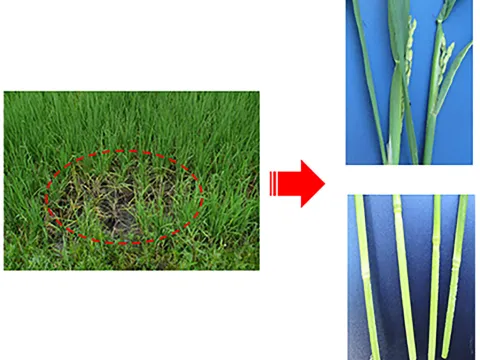
The most diagnostic sign is the formation of white, yellowish, or black streaks on the stems and leaf sheaths caused by tissue proliferation.
Infected plants exhibit severe stunting, characterized by shortened internodes and a rigid, dark green appearance of the leaves.
Maize plants often show excessive tillering and fail to produce ears, or if they do, the ears are small, deformed, and poorly filled with grains.
Rice plants infected at an early stage suffer from twisted leaves and an inability to properly develop panicles, often remaining sterile.
The root system of infected individuals is typically underdeveloped, rendering the plant more vulnerable to drought and nutrient deficiencies.
The primary strategy for controlling RBSDV is the deployment of resistant or tolerant crop cultivars within affected agricultural regions.
Sanitation practices, such as removing alternative weed hosts that harbor the virus and the planthopper vector, are essential for reducing inoculum sources.
Targeted insecticidal applications should be timed to suppress planthopper populations precisely when crops are in their most vulnerable stages.
Adjusting planting dates can help growers miss the peak migration windows of Laodelphax striatellus, thereby reducing the likelihood of early infection.
Continuous monitoring programs using yellow sticky traps help track vector movement, enabling farmers to make informed decisions regarding chemical control.