
Rice blast
Water-seeded rice
Description
How to identify
Rice blast is caused by the ascomycete fungus Pyricularia oryzae (teleomorph Magnaporthe oryzae), which is recognized as one of the most destructive plant pathogens in rice production worldwide.
The fungus survives between seasons as mycelium or conidia on infected crop residues, weeds, and within the seed coat. These reservoirs serve as the primary inoculum for new plantings.
The pathogen consists of septate hyphae and produces pyriform, colorless conidia. These spores are wind-dispersed and require high humidity or free water on plant surfaces to germinate effectively.
Optimum conditions for disease development include temperatures ranging from 25 to 28 degrees Celsius combined with high relative humidity, often triggered by prolonged dew or fog.
In aquatic rice-growing systems, water movement and splashing droplets help disseminate the fungus, allowing it to spread rapidly across large fields during periods of environmental stress.
What it damages
The disease affects every part of the plant, including leaves, stems, nodes, and panicles. Nodes are particularly vulnerable, and their infection frequently leads to crop failure.
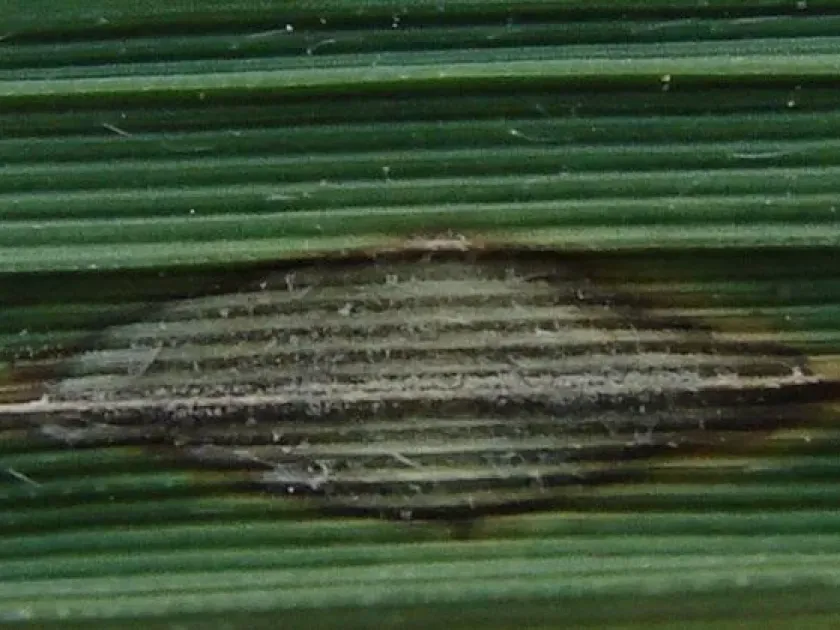
Leaf lesions typically start as small spots that expand into characteristic diamond-shaped patches. When severe, these lesions coalesce, killing large portions of the leaf tissue and reducing photosynthesis.
Stem node infection causes the plant to become brittle and prone to lodging. This structural damage disrupts the transport of nutrients from the roots to the developing grain.
Panicle blast occurs when the neck of the panicle is infected. This leads to partial or total grain sterility, resulting in empty panicles that are often white and dried out.
The economic impact is profound, with global yield losses estimated at 10 to 30 percent annually, though individual field losses can reach nearly 100 percent in susceptible varieties under severe conditions.
When it appears
The disease can manifest at the seedling stage if the seeds were contaminated; however, the most critical infection period occurs from late tillering through the heading stage.
Late summer months with significant day-night temperature fluctuations are highly conducive to disease, as heavy night dew provides the necessary moisture for fungal colonization.
High nitrogen fertilization rates promote rapid, succulent vegetative growth, which is significantly more susceptible to P. oryzae invasion than slower-growing, hardened tissues.
The latent period of the fungus—the time between infection and the production of new spores—is very short, often less than one week under optimal weather conditions.
Because of this rapid reproduction, multiple cycles of infection can occur within a single growing season, leading to sudden and severe outbreaks.
Signs of infestation
The primary symptom is the appearance of leaf lesions. These are typically elongated, spindle-shaped spots with necrotic grey centers and reddish-brown borders.
Node infection is indicated by a blackening of the node tissue, which often becomes soft or rotten. This physical collapse is often the first indicator of systemic spread.
Panicle blast is easily recognized by the 'blasted' appearance of the head, where the neck turns brown and the entire panicle above the lesion fails to fill, remaining empty and standing upright.
- Lesions with greyish centers on leaf surfaces.
- Dark, necrotic patches on nodes and leaf sheaths.
- White, sterile panicles at maturity.
- Decreased grain weight and milling quality.
Field scouting for early symptoms is critical. Early detection allows for immediate intervention, which is essential given how quickly the pathogen can multiply.
Control measures
The cultivation of genetically resistant rice varieties remains the most effective and sustainable strategy for managing rice blast on a large scale.
Good agricultural practices include precise nitrogen management to avoid over-fertilization and the prompt destruction of infected straw and stubble to reduce inoculum.
Managing water depth and drainage is essential, as maintaining proper air circulation in the lower canopy can significantly reduce the moisture levels needed by the fungus.
Chemical control involving systemic fungicides is used to protect the crop during critical growth phases, specifically at the booting and heading stages.
Integrated pest management (IPM) strategies, which combine resistant varieties with balanced nutrient programs and judicious fungicide use, provide the best protection against this pathogen.
Discussion
No discussions yet — be the first.