
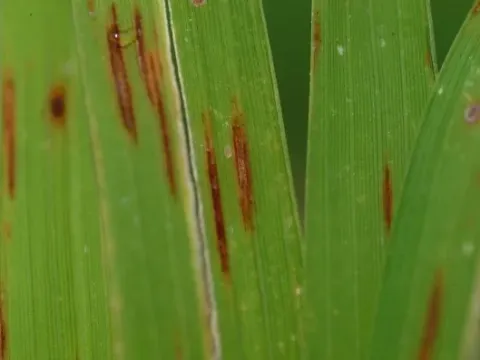
Rice cercospora leaf spot
Cercospora janseana
The causative agent of the disease is the imperfect fungus Cercospora janseana (synonym Cercospora oryzae), which belongs to the Ascomycota division. This pathogen is a highly specialized parasite that primarily targets rice cultivation worldwide.
What the section contains
Rice cercospora leaf spot
The fungal mycelium spreads within the plant tissues, producing conidia on the surface of infected lesions. The dissemination of the pathogen occurs mainly through wind currents and splashing rain, which facilitates rapid secondary cycles of infection across the field.
The life cycle of the fungus includes survival on crop residues, where it can persist during the off-season. Primary infection starts when conidia land on healthy leaves and penetrate the tissue, initiating the disease cycle under favorable weather.
The fungus thrives in conditions of high humidity and moderate temperatures. The optimal range for mycelial growth and sporulation is between +22°C and +28°C, with high relative humidity playing a crucial role in disease progression.
Identification is confirmed through laboratory analysis, observing the characteristic conidiophores and conidia on the leaf spots. Distinguishing this from other leaf spots requires microscopic examination of the lesion surface.
The primary host for this pathogen is rice (Oryza sativa). The infection causes a significant reduction in the functional leaf area, which severely impairs the plant's photosynthetic capacity during critical stages of grain filling.
Severe infections lead to the premature death of leaves, causing a decrease in nutrient transport to the grain. This ultimately results in lower grain yield, smaller grain size, and reduced milling quality, often leading to significant economic losses.
Beyond leaf blades, the disease can affect leaf sheaths, stems, and glumes. In cases of epidemic outbreaks, yield losses can range between 15% and 30%, depending on the timing of the infection and the susceptibility of the rice variety.
The damage is compounded by the weakened physiological state of the plants, making them more susceptible to lodging and secondary infections by opportunistic pathogens. This reduces the overall efficiency of the crop stand.
Quality degradation is a major concern, as the disease reduces the weight of 1000 grains and can affect the protein and starch content of the harvest. This limits the commercial value of the produced rice.
The first signs of the disease appear as narrow, linear brown spots running parallel to the leaf veins. As the lesions mature, the center of the spot turns grey or ash-colored, contrasting with the dark brown border surrounding it.
On leaf sheaths, the spots may appear darker and more irregular in shape. Under high humidity, a delicate, greyish fungal growth (sporulation) becomes visible on the underside of the leaf, which is a definitive sign of Cercospora presence.
The disease usually becomes prominent during the mid-to-late growth stages of the rice plant. The spots initially appear on lower leaves and gradually move upwards towards the flag leaf, which is critical for grain development.
Plants severely affected by the disease appear scorched or prematurely dried. The loss of chlorophyll in the affected areas reduces the overall green canopy of the field, leading to visible yellowing and senescence.
Unlike other rice leaf spots, Cercospora lesions are consistently restricted by the leaf veins, giving them a distinct, elongated, and narrow shape. This feature is the most reliable visual marker for field scouting.
Management begins with the use of resistant rice cultivars and the implementation of effective crop rotation. Removing or deeply incorporating crop residues is essential, as they serve as the primary inoculum source for the next season.
Optimizing nitrogen fertilization is critical; excessive nitrogen levels can increase plant susceptibility to fungal attack. Balanced nutrition, particularly with sufficient potassium, can strengthen the plant's defense mechanisms.
Chemical control involves the application of systemic fungicides at the early onset of disease symptoms. Triazoles and strobilurins are widely used to effectively inhibit mycelial growth and prevent further sporulation.
Regular field scouting is necessary to determine the right timing for fungicide application. Adherence to label instructions and considering the growth stage of the rice are vital for achieving maximum effectiveness.
- Planting resistant or tolerant rice varieties;
- Deep plowing to bury infested plant debris;
- Maintaining balanced soil fertility, especially potassium levels;
- Applying fungicides at the first sign of symptoms;
- Effective weed management to eliminate secondary hosts.