Late winter variety of folk selection. Currently excluded from the State Register (regionalization), but still found in old gardens of central Russia.
Medium-sized trees with a wide, round, spreading crown composed of thick, upward-arching main branches. Fruit set is mainly concentrated on spurs, rarely on lateral shoots.
Medium-thick, light-colored, slightly hairy shoots. Buds on shoots are elongated and whitish. Vegetative buds are small, flat, tightly pressed against the shoot, slightly hairy. Leaves are medium-sized, broad, nearly round, with large rounded teeth, often lobed, slightly hairy, light green, coarse, tough, with irregular, pitted surface and curled-up margins and tips (spade-shaped). Base of leaf may be notched. Petioles are medium in length and thickness, slightly hairy. Stipules are narrow and short. In nurseries, one-year-old plants show moderate growth. Leaves are broad, elliptical or broadly egg-shaped, tough, very slightly hairy, light green, slightly curved along the main vein, with uplifted margins. Petioles are short. Buds are very small, pressed against the shoot, triangular in shape.
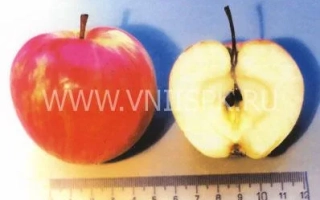
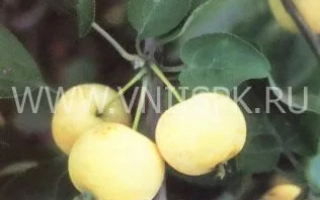
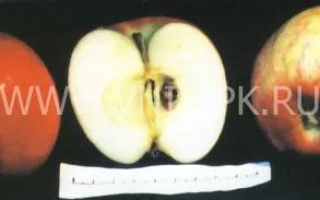
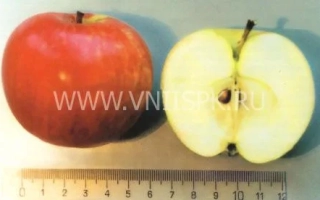
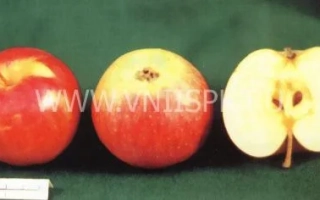
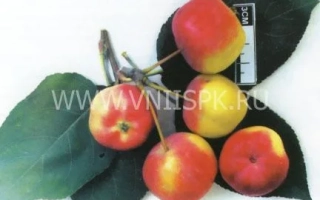
Fruits (see picture) are medium or smaller, strongly flattened, round or turnip-shaped with wide ribs, sometimes dividing the fruit into several lobes. Main color is green, turning yellow upon ripening. Skin coloration is absent, but on the sun-exposed side of the fruit, a delicate blush may form. Pedicel is short. Calyx is shallow and wide, rust-colored. Receptacle is small and wide. Calyx is closed. Heart is bulbous, poorly expressed, chambers are closed. Subcalyx tube is short. Seeds are fairly large, elongated, light brown in color.
Flesh is white, juicy, finely textured, with a wine-like flavor, excellent sweet-sour taste. Chemical composition of fruits: total sugar — 10.6%, titratable acids — 0.74%, ascorbic acid — 23.7 mg/100g, P-active substances — 229.2 mg/100g, pectin substances — 12.1%.
Fruits drop off significantly upon ripening.
Babushkino fruits are eaten fresh and are excellent raw material for compotes and jams.
The variety is characterized by late fruiting (starting at 8-10 years, sometimes later). In mature trees, yield is moderate and irregular year-to-year. In the Oryol region, it shows adequate winter hardiness.
Advantages of the variety: long storage life of fruits and good taste.
Disadvantages of the variety: late fruiting, strong leaf drop in the second half of summer.
Four new varieties were created using Babushkino, including Antey [Belarusian red apple (Babushkino x Newton)] and Vesenka [(Joyce x Welles) x (Babushkino x Lavfam)], developed at Belarusian Research Institute of Pomology.