Late-season variety obtained at the Scientific Research Institute of Horticulture of Siberia named after M. A. Lisavenko by pollinating Altai Bluebird in 1958 with a pollen mixture of the varieties Gornoy Altai, Altai Dessert, Altai Sweet, and Altai Pepinka. Breeders: M. A. Lisavenko, I. P. Kalinina, N. V. Yermakova. Approved for the West Siberian region in 1985.
Trees are medium-sized with a pyramidal crown of moderate density. Main branches diverge from the trunk at acute angles. The main yield is formed on ring buds and fruiting spurs.
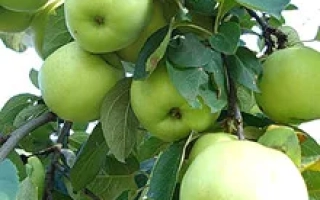
Shoots are straight, brownish-brown, hairy. Leaves are medium-sized, broadly egg-shaped, long-pointed, hairy underneath, with serrated and wavy margins. Petioles are of medium length, thick, reddish, stipules are elongated.
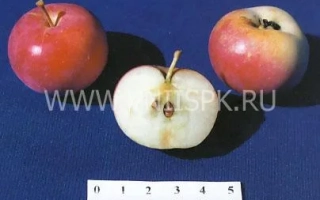
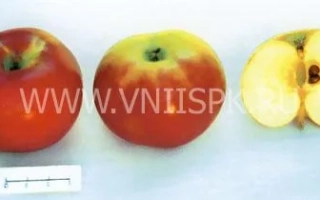
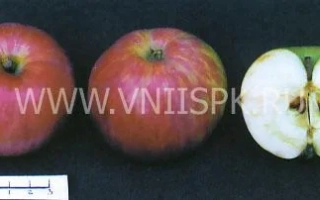
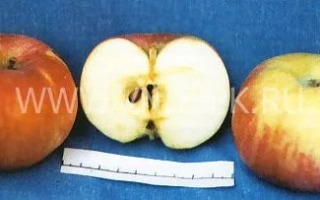
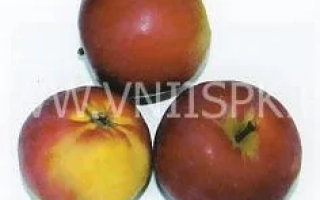
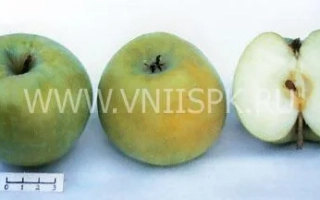
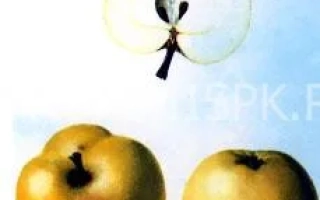
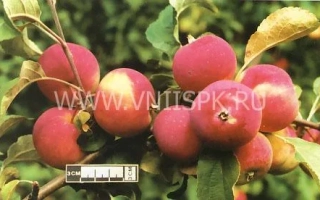
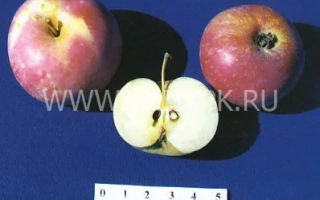
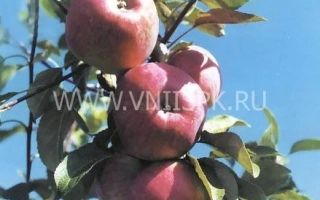
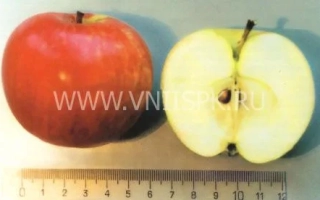
Fruits (see illustration) are small (56–71 g), round, with smooth surface. Main color is yellow, appearing as spots through the dark-red covering color, diffused throughout the fruit. Peduncle is of medium length and thickness, with wide calyx, golden-brown discoloration. Receptacle is medium-sized, smooth. Calyx is closed, subcalyx tube is medium-sized, cup-shaped. Seed chambers are half-open.
Flesh is rose-colored with red veins, finely granular, juicy, slightly sour-sweet, aromatic, good flavor. Chemical composition of the fruit: total sugars — 12.9%, titratable acids — 1.0%, ascorbic acid — 29.9 mg/100g, P-active substances — 121 mg/100g.
Fruits ripen in the second half of August, may be stored up to 60 days. Variety is of universal use.
Fruit production begins on the 4th–5th year. Average yield, regular fruiting. High winter hardiness. Medium resistance to scab.
Advantages of the variety: high winter hardiness, regular fruiting, good flavor of fruits suitable for late-season consumption.
Disadvantages of the variety: medium resistance to scab.