Summer variety developed at the Far Eastern Research Institute of Agriculture by A.V. Bolonyev, from a cross between Augustovskoe Far Eastern and Ribbed. One of the best varieties of Far Eastern selection. In terms of fruit size and quality, it is similar to Moscow's Grushovka. Grown on its own rootstock in Primorsky Krai and southern regions of Khabarovsk Krai. Also grown on cold-resistant and frost-resistant rootstocks in collective and private gardens of the Jewish Autonomous, Amur, and Sakhalin regions. Grown as a cordon with winter protection in the Northern zone, along the BAM highway.
Moderately sized tree with a round-oval crown. Main branches are sparsely distributed at right angles, promoting good crown illumination. Branches are numerous, with grayish-brown bark. Flower buds form on one- and two-year-old shoots of varying lengths and at the ends of one-year-old shoots.
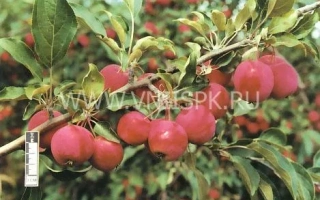
Shoots are moderately thick, hairy, dark brown, slightly curved. Leaves are large, slightly wrinkled, dark green on top and light green underneath, hairy, with convex veins.
Flowers are fairly large, on short pedicels, slightly hairy. Petals are oval-shaped, white, stamens are large, pale greenish, positioned above the stigma column. Ovule is large and hairy.
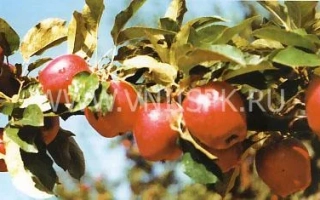
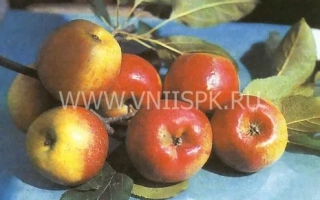
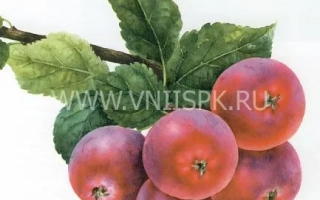
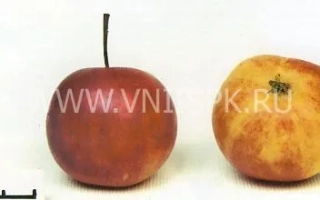
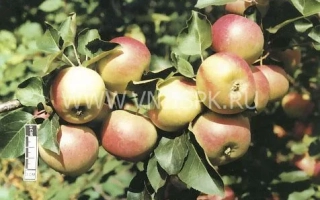
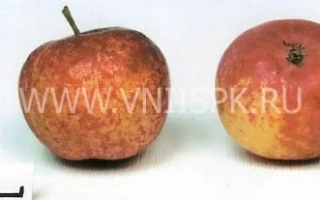
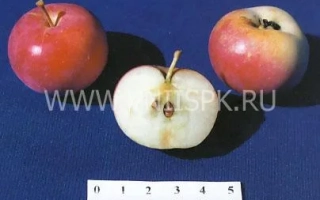
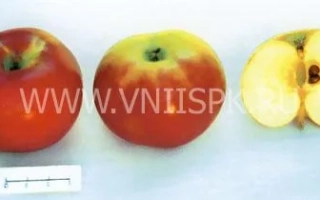
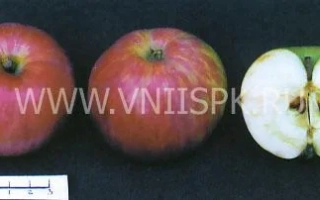
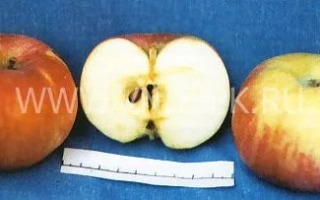
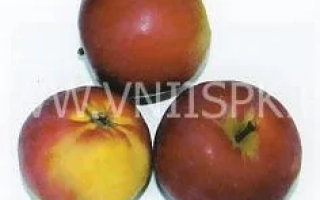
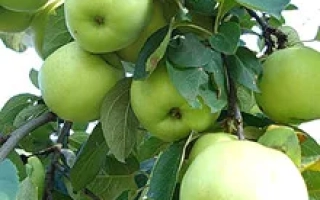
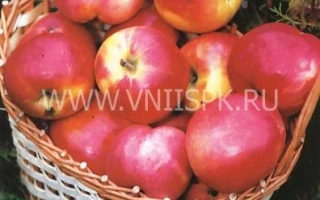
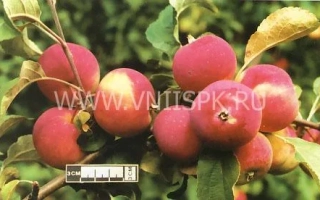
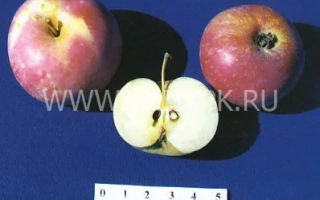
Fruits are small (average weight 50 g, maximum 130 g), oval-shaped. Fruit surface is smooth and shiny. Main color is light yellow, with a striped or diffuse bright red blush. Pedicel is medium in length and thickness, greenish-brown, situated in a medium-sized and deep depression. Calyx is non-deciduous, with a medium-depth indentation and small ribs.
Individual fruits become juicy upon ripening and are suitable for immediate consumption from the tree. Flavor is pleasant, slightly tart-sweet with a mild astringency. Fruits contain: dry matter — 14.75%, total sugar — from 8.8 to 11.9%, acid — from 0.67 to 0.78%, tannins — from 0.27 to 0.31%, pectin — from 0.3 to 0.5%, ascorbic acid up to 11.1 mg/100g.
Fruits ripen in late August. Fruit attachment is satisfactory. Ripened fruits with juice drop off under strong winds. Fruits remain fresh for 20 days, and in cold storage facilities up to 40 or more days. Fruit quality — up to 85-90%.
Fruits are in demand on the market. Consumed fresh and used for compotes and pickling.
Variety is partially self-fertile but requires pollinators. Yields high in mixed plantings with varieties: Amur Yarostnoe and Augustovskoe Far Eastern.
Trees begin fruiting on the third to fourth year after grafting, mass fruiting occurs on the 6th to 8th year. At five years old, yield is 7-8 kg; at eight years — 28.6 kg; at ten years — 52.6 kg. Highly resistant to monilial burn and scab.
Advantages of the variety: relatively large fruits of good flavor, full resistance to monilial burn and scab, fruits are in demand on the market.
Disadvantages of the variety: short storage and consumption period for fresh fruit, limited tree lifespan.
According to cytological studies, the variety is recognized as a tetraploid-diploid chimera.
Used in breeding at the polyploid level to develop triploid forms.