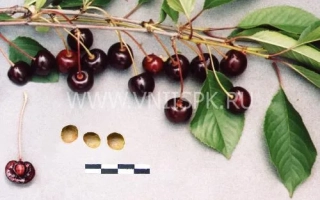
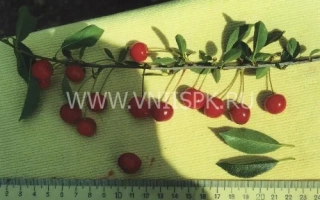
Variety selected by the North Caucasus Regional Institute of Horticulture and Viticulture (Krasnodar), obtained through hybridization of the cherry varieties Caucasian and French Black. Undergoing state variety testing in the North Caucasus zone since 2001. Author E.M. Alekhina.
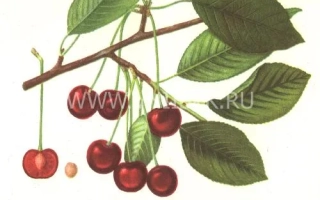
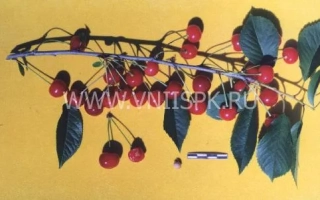
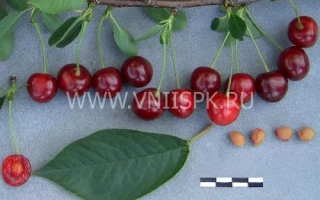
Medium-sized tree with moderate growth, spherical and spreading crown, slightly raised, of medium density. Buds of medium size, vegetative buds conical, generative buds oval. Leaves of medium size (16.5 x 8), oval, dark green, with pointed apex and rounded base, double-toothed margin, upper surface matte and smooth, lower surface with slight pubescence. Petiole short, medium thickness, green with anthocyanin. Stipules arranged in pairs on the petiole with anthocyanin. Flowers arranged in clusters of 2-3, large, corolla saucer-shaped, petals oval, white, calyx cup-shaped, sepals without serrations, stamens of medium length, pistil long. Main fruiting concentrated on cluster branches containing more than 7 generative buds.
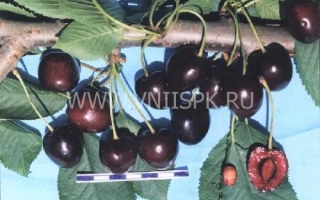
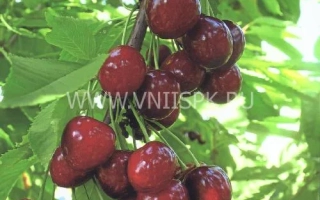
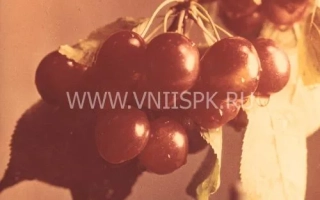
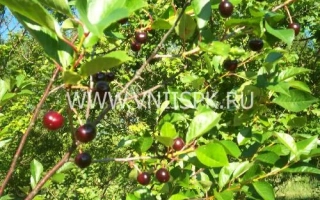
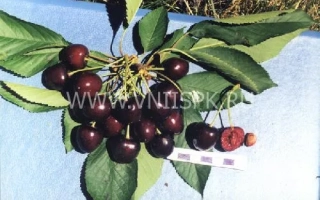
Fruits large (average weight 8.0 g, maximum 10.0 g), broad-acute heart-shaped (27 x 29 x 22 mm), apex slightly elongated and pointed, wide shallow pit, small. Skin color dark red with lighter shade along the seam, flesh with ruby hue, juicy, medium density, juice dark red. Distinguished by very attractive, original shape (attractiveness score 4.8 points), high flavor (taste evaluation 4.6 points) and commercial qualities, easily detach from the pedicel with dry separation. Fruits contain 19.6% dry matter, 13.3% sugars, 0.64% acids, 9.7 mg/100g ascorbic acid. Main use: dessert.
Belongs to varieties with medium flowering and medium-early ripening periods. Enters fruiting at age 5. Self-sterile. Yield during full fruiting reaches 9.1 t/ha. Shows resistance to frost and freezing, moderately resistant to major fungal diseases. Slightly damaged by pests (aphids, cherry fly).
Advantages: attractive, large-fruited, medium-early ripening varieties.
Disadvantages: moderate resistance to fungal diseases.