The variety was obtained in Germany (Saxony) and named after the breeder Drogana. Its origin is unknown. One of the oldest and most widely distributed varieties. Grown in Astrakhan and Volgograd regions, various areas of the North Caucasus region, Ukraine, Moldova, Belarus, Georgia, Armenia, Azerbaijan, and Central Asian republics. Approved for cultivation in the North Caucasus and Lower Volga regions since 1947.
Tree is vigorous, with a dense, broadly round or round-conical, well-leafed crown. Shoots are straight, light-brown, with greenish tinge, covered with a bluish bloom, small and round buds. Vegetative buds are dark-brown, medium-sized, conical; generative buds are light-beige, oval, slightly deviated from the shoot. Leaf is large (170 x 70 mm), flat, elongated-oval, dark-green, elastic, medium-thick, apex strongly pointed, base acute, margin doubly serrated, no pubescence. Petiole has two large, bean-shaped yellow glands located on the petiole or at the base of the leaf. Petiole is green, medium length and thickness. Flowers are grouped in clusters of 2-3, medium-sized, with a saucer-shaped corolla, round overlapping white petals, bell-shaped calyx, no toothed sepals. Stigma is medium-sized, positioned at the same level as the anthers. Main flowering and fruiting are concentrated on flower clusters and partially at the base of last year’s shoots.
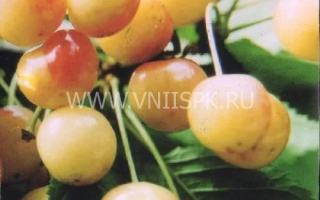
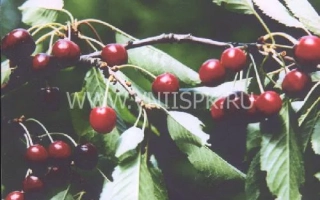
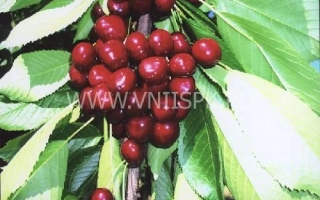
Fruits are above average size (average weight 6.5 g, maximum 8.0 g), round-heart-shaped (2.2 x 2.5 x 2.2), rounded apex, deep and wide depression. Skin color is yellow, flesh is light-yellow, firm, sweet, good quality (taste rating 4.3 points), juice is transparent and colorless. Stone is elongated-oval with rounded apex and base, light-beige color, medium size, poorly separates from flesh. Peduncle is long, medium thickness, separates well from fruit. Fruits contain 17.4% dry matter, 13.4% sugars, 0.2% acids, 6.6 mg/100g ascorbic acid.
Fruits are not sufficiently transportable. Suitable for general use, produce high-quality products when processed into compotes. Good for jam and drying, unsuitable for freezing.
Flowering and ripening periods are late, fruits ripen almost simultaneously, at the end of June. Begins fruiting at age 4-5 years, high productivity period up to 25 years. Self-incompatible. Fruit yield is reliable, under normal conditions average is 8.0-9.2 t/ha. In some years maximum yield reaches 22.0 t/ha. Fruit attachment to tree is strong.
Winter hardiness of generative buds is high; flowers rarely suffer from spring frosts due to late development. Multi-year wood and one-year shoots are rarely damaged. Drought resistance is sufficiently high. Resistant to major fungal diseases, but under rainy weather fruits crack and are affected by gray fruit rot of stone fruits at medium severity, severely attacked by cherry fly.
Advantages: reliable yield, high quality of processed products.
Disadvantages: poor transportability, strong damage by cherry fly, affected by gray fruit rot.