


SKU #63678
·
59 views
KITROSSA
Soybean
User rating
0 votes0% positive reviews
No ratings yet — be the first.
Growing Season
110-120 days
Plant; plant height
70-80cm
Seeds: oil content
20-21%
Seeds: protein content
39-41%
About product

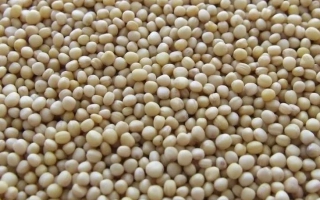
Kitrossa is a medium-maturing soybean (Glycine max (L.) Merr.) variety of semi-determinate growth type, intended for grain production as well as for food and feed purposes. Plants of this variety have low or medium height, ranging from 71 to 97 cm, with gray pubescence on the main stem and lanceolate lateral leaflets. Flowers are white, seeds are of medium size, elongated, yellow with a yellow hil…
Growing Season
110-120 days
Plant; plant height
70-80cm
Seeds: oil content
20-21%
Seeds: protein content
39-41%
Description
Kitrossa is a medium-maturing soybean (Glycine max (L.) Merr.) variety of semi-determinate growth type, intended for grain production as well as for food and feed purposes. Plants of this variety have low or medium height, ranging from 71 to 97 cm, with gray pubescence on the main stem and lanceolate lateral leaflets. Flowers are white, seeds are of medium size, elongated, yellow with a yellow hilum. The vegetative period is about 112-114 days, and the time of flowering onset is very early. The mass of 1000 seeds varies within 145-186 g, while the protein content in seeds reaches 39.9-42.0% and fat content is 20.6%.
The variety is resistant to lodging and has complex resistance to fungal and bacterial diseases, which contributes to stable and high yields. Average yield in the recommended regions for cultivation — Amur Oblast and Primorsky Krai — is about 22.9-23.9 centners per hectare, while the maximum yield indicators reached 40.1 centners per hectare in Primorsky Krai and 27.4 centners per hectare in Amur Oblast.
Research conducted under field conditions showed that the optimal sowing method for the Kitrossa variety is wide-row sowing with a row width of 45 cm. This method ensures better pod and seed formation, which significantly increases yield compared to narrow-row sowing. When plant density is increased with narrow-row sowing, a decrease in the number of pods and, accordingly, yield is observed. Thus, for maximum realization of the variety's potential, wide-row sowing is recommended.
The variety is resistant to lodging and has complex resistance to fungal and bacterial diseases, which contributes to stable and high yields. Average yield in the recommended regions for cultivation — Amur Oblast and Primorsky Krai — is about 22.9-23.9 centners per hectare, while the maximum yield indicators reached 40.1 centners per hectare in Primorsky Krai and 27.4 centners per hectare in Amur Oblast.
Research conducted under field conditions showed that the optimal sowing method for the Kitrossa variety is wide-row sowing with a row width of 45 cm. This method ensures better pod and seed formation, which significantly increases yield compared to narrow-row sowing. When plant density is increased with narrow-row sowing, a decrease in the number of pods and, accordingly, yield is observed. Thus, for maximum realization of the variety's potential, wide-row sowing is recommended.
Crop & resistance
Crop
Specifications
| Growing Season | 110-120 days |
|---|---|
| Plant; plant height | 70-80cm |
| Seeds: oil content | 20-21% |
| Seeds: protein content | 39-41% |
| Registration year | 2016 |
| Catalog | Catalog → Soybean |
| Legal data |
Show · 2 |
| Country | Russia |
Store offers
Prices are updated on loadLoading offers…
Available at: Свое Фермерство
Aggregator catalog: prices are collected automatically from store websites, normalized by AI and converted at the current exchange rate. Before ordering, confirm the price and availability on the store's website. This block is not indexed by search engines — the data is loaded after the page opens.
Not yet комментариев. Be the first!
Alternatives
Soybean seeds · similar varieties





See also
Often considered together with this variety








Recently viewed
Products you’ve viewed on this site
Reviews · 0