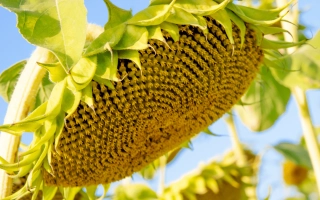
Dacia hybrid sunflower is a medium-maturing, high-oil content variety with a vegetation period of 110-115 days. Plants reach a height of 165-180 cm, have large triangular green leaves and convex flower heads directed downward at the upper part of the stem. Leaves are medium-sized with slight reticulation, and the pubescence at the upper part of the stem varies from weak to moderate. Flowers are yellow, tubular, and tongue-shaped, with no anthocyanin staining on the stigma. Seeds are medium-sized, narrowly oval, with a main black coloration and distinct marginal stripes. The hybrid exhibits high resistance to diseases such as Phomopsis and Phomopsis, as well as to plant parasites. The 1000-seed mass is 50-55 g, oil content in dry seeds reaches 51-53%, and in the kernel — 65-70%. The potential yield of the hybrid is 4.0-4.5 t/ha, with an optimal planting density of 50-55 thousand plants per hectare on commercial plots. Average seed yields in the Central Chernozem region reach 29.7 centners/ha, and in the North Caucasus — 21.9 centners/ha, exceeding the standard level by 5.4-5.5%. High yields were recorded in Lipetsk Oblast and Krasnodar Krai. Hybrid Dacia is recommended for cultivation in the Central Chernozem and North Caucasus regions, as well as in Lipetsk Oblast. Due to its high oil content and disease resistance, it is an advantageous choice for agricultural producers aiming to obtain a stable and high-quality sunflower crop. The plant does not branch, simplifying care and harvest, and the high oil content of the seeds ensures efficient oil production.