


SKU #63307
·
38 views
BRUNSVIC
Onion
ZAO 'KOMPANIYa LANS'User rating
0 votes0% positive reviews
No ratings yet — be the first.
Type
Onion
Direction
Salad
Maturation Period
120 - 130 days
Harvest Method
Manual
Store offers · 4 from 4 stores
Prices are updated on loadLoading offers…
Available at: Екомалина · Райська Долина · Сади Валерії · Traskovskyi · Все Росте
Aggregator catalog: prices are collected automatically from store websites, normalized by AI and converted at the current exchange rate. Before ordering, confirm the price and availability on the store's website. This block is not indexed by search engines — the data is loaded after the page opens.
About product

The Brunsvic onion is a medium-maturing Dutch variety adapted to Russian climatic conditions. The bulbs have an oblate shape and weigh between 70 and 115 grams. The outer scales are dark red, while the inner ones are white with red rings. The onion has a semi-sharp taste, making it versatile for various culinary purposes. The variety is recommended for growing as a one-year crop from seeds; it doe…
Type
Onion
Direction
Salad
Maturation Period
120 - 130 days
Harvest Method
Manual
Description
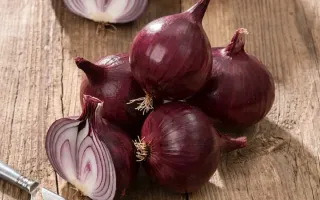
The Brunsvic onion is a medium-maturing Dutch variety adapted to Russian climatic conditions. The bulbs have an oblate shape and weigh between 70 and 115 grams. The outer scales are dark red, while the inner ones are white with red rings. The onion has a semi-sharp taste, making it versatile for various culinary purposes. The variety is recommended for growing as a one-year crop from seeds; it does not have special soil requirements, good drainage and aeration are the main things. It prefers fertile, non-acidic, moisture-retentive soils, as well as sunny planting sites. Seeds can be sown both in open ground and as seedlings. Seeds are sown at a depth of 1.0-1.5 cm into prepared, moistened soil, usually in April when the soil is already ready. When sowing, it is important to observe a planting scheme of 15x15 cm, while growing seedlings, sow in January-February. Seedlings appear in 20-30 days, after which they are thinned to a distance of 1-1.5 cm between plants. To obtain large bulbs, it is recommended not to pull green shoots. Regular watering, feeding with mineral fertilizers, and loosening the soil after watering contribute to good plant development. Harvest is carried out in August-September when leaves begin to yellow and lean. Watering stops 15 days before harvesting so that the bulbs mature better and are suitable for long-term storage. The onions are dug up, dried on the bed under the sun for 3-5 days, then finally dried under a shelter for 1-2 weeks. After this, withered stems are cut off, leaving a neck length of 4-5 cm, and stored in a dark, cool, and well-ventilated room. The Brunsvic variety is characterized by good shelf life and is suitable for growing in various regions due to its unpretentiousness and resistance.
Video · 2 videos
Suggest a video →Specifications hover over for a hint about the specification
|
Type
Type
Galia (Galia) type — relatively new, of Israeli origin, although there are indications that this variety may originate from Spain. The fruits of this type are round or oval, weighing about 1 kg. The surface is smooth, covered with a delicate, connected netting, turning yellow whe... |
|
|---|---|
|
Direction
Direction
Existing varieties and types of cabbage are grown for fresh consumption, long-term storage, and technical processing. |
|
|
Maturation Period
Maturation Period
Vegetation period from emergence to technical maturity 30-50 days. |
120 - 130 days |
|
Harvest Method
Harvest Method
Most existing onion varieties are harvested manually. This is because onion bulbs are very sensitive to mechanical damage. However, there are varieties whose bulbs have a hard consistency and are suitable for mechanical harvesting. |
|
|
Onion bulb; color
Onion bulb; color
Distinguish two main colors of the onion bulb in cross-section. Specifically, white (possibly greenish-white) and red (pink) color. |
|
| Onion bulb; skin color | |
|
Cormus; shape
Cormus; shape
The shape of corms is quite diverse and can be flattened, round, and elongated. |
|
|
Onion bulb; weight
Onion bulb; weight
The weight of an onion bulb can reach 500–800 grams at sparse planting. |
80 - 90 grams, 90 - 100 grams |
|
Storage
Storage
Depending on the variety characteristics, the storage period for heads may vary from one month for early varieties to eight months for late cabbage varieties. |
6 - 7 months |
| Registration year | 2008 |
| Catalog | Catalog → Onion |
| Manufacturer | ZAO 'KOMPANIYa LANS' |
| Legal data |
Show · 1
|
| Country | Russia |
Not yet комментариев. Be the first!
Alternatives
Onion seeds · similar varieties




See also
Often considered together with this variety





Recently viewed
Products you’ve viewed on this site
Reviews · 0