


Prices in stores
No offers yet — stores have not added prices for this product yet.
Similar varieties with prices
All offers: Hungarian Millet
Plant Height
90-110
Purpose
Feed and Grain
Stem Type
Erect
Registration year
1995
Your mark
0 votes
0% positive ratings
Description
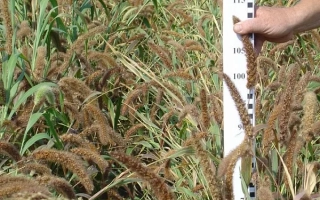
The mogara variety «STAMOGA» consists of an erect bush 90–95 cm high with weak branching. The plants are characterized by accelerated initial growth and medium dry matter yield – about 93 cts/ha, which significantly exceeds standard varieties. The vegetative period is about 65 days from germination to harvest for feed, and 103 days for seed production.
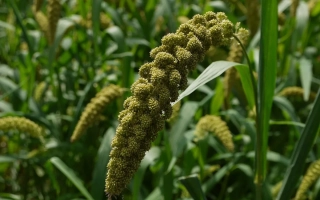
Key characteristics: all plants have anthocyanous sprouts and weakly anthocyanous leaves, which gives them a characteristic color. The panicle is loosely compressed, acutely cylindrical, 15–20 cm long, covered with dense weakly anthocyanous bristles. The grain is elliptical and yellow; the mass of 1000 seeds is 2.8 g. Seeds easily germinate at a soil temperature of 10–12 °C, however, sprouts are sensitive to frost.
Advantages: the variety is drought-resistant at the level of standard varieties and is not affected by diseases or pests in the observed experiment. It is suitable for both green feed production (up to 20 t/ha) and seed harvesting, while grain yield reaches 3.05 t/ha. «STAMOGA» seeds are rich in protein and oil, making them a valuable feed product.
Care: sowing at a depth of 2–4 cm followed by rolling is recommended, as well as regular soil crust destruction and weed control. With proper sowing in row sowing, the sowing rate is 12–22 kg/ha, in wide-row sowing – 8–12 kg/ha.
The «STAMOGA» variety is widely applicable in various climatic zones and can be used both for hay production (up to 6 t/ha) and for haylage, silage or bird feed. Due to its resistance to unfavorable conditions and high yield, it is the preferred choice for farmers seeking to increase the productivity of their pastures.
Key characteristics: all plants have anthocyanous sprouts and weakly anthocyanous leaves, which gives them a characteristic color. The panicle is loosely compressed, acutely cylindrical, 15–20 cm long, covered with dense weakly anthocyanous bristles. The grain is elliptical and yellow; the mass of 1000 seeds is 2.8 g. Seeds easily germinate at a soil temperature of 10–12 °C, however, sprouts are sensitive to frost.
Advantages: the variety is drought-resistant at the level of standard varieties and is not affected by diseases or pests in the observed experiment. It is suitable for both green feed production (up to 20 t/ha) and seed harvesting, while grain yield reaches 3.05 t/ha. «STAMOGA» seeds are rich in protein and oil, making them a valuable feed product.
Care: sowing at a depth of 2–4 cm followed by rolling is recommended, as well as regular soil crust destruction and weed control. With proper sowing in row sowing, the sowing rate is 12–22 kg/ha, in wide-row sowing – 8–12 kg/ha.
The «STAMOGA» variety is widely applicable in various climatic zones and can be used both for hay production (up to 6 t/ha) and for haylage, silage or bird feed. Due to its resistance to unfavorable conditions and high yield, it is the preferred choice for farmers seeking to increase the productivity of their pastures.
Specifications
| Plant Height | 90-110 |
|---|---|
| Purpose | |
| Stem Type | |
| Registration year | 1995 |
| Catalog | Catalog → Hungarian Millet |
| Manufacturer | North Caucasian FARC |
| Legal data |
Show · 7
|
| Country | Russia |
No reviews yet. Be the first to share your experience.
Alternatives
Hungarian Millet · similar varieties




See also
Often considered together with this variety



Recently viewed
Products you’ve viewed on this site
Reviews